Are you ready to unlock an army of world-class engineers without payroll headaches, visas, or hidden costs?
Software Engineering as a Service
Release the brake on your engineering
Most companies grow more slowly than they could; not because their product is weak, but because their technical infrastructure is fragile. The story is always the same: months wasted on interviews, recruiters, onboarding, contracts, turnover. Meanwhile, the market moves. Someone launches a new feature before you.

Someone else secures the investors you were targeting. Another competitor comes out of stealth mode and overtakes you while you're still searching for "the right developer".
When speed becomes the real competitive currency , the traditional hiring process stops being a method and becomes a drag. It's like trying to push a sports car with the handbrake on: you feel like you're moving, but you're only wasting energy.
Red Rock exists to release that brake.
When speed becomes the real competitive currency , the traditional hiring process stops being a method and becomes a drag. It's like trying to push a sports car with the handbrake on: you feel like you're moving, but you're only wasting energy.
Red Rock exists to release that brake.
A New Paradigm
You don't hire people You activate technical power
Imagine being able to switch on an entire engineering force the way you start a machine: key, ignition, acceleration. No waiting, no friction, no bureaucratic processes draining weeks of momentum.
With Software Engineering as a Service, that's exactly what happens. We connect you directly with engineers who aren't "hours for sale" but true extensions of your team: full-time, fully integrated into your workflows, and trained with the discipline and quality standards that define everything produced under Red Rock.
It's like adding horsepower to your engine: the vehicle stays the same, but its ability to win changes completely.
With Software Engineering as a Service, that's exactly what happens. We connect you directly with engineers who aren't "hours for sale" but true extensions of your team: full-time, fully integrated into your workflows, and trained with the discipline and quality standards that define everything produced under Red Rock.
It's like adding horsepower to your engine: the vehicle stays the same, but its ability to win changes completely.
How it really works
A discipline that turns into momentum
They arrive already trained, already tested, already synchronized with our performance standards.

Step 01
We understand your goal
The real direction — not just a checklist of features. We learn your product, decision rhythm, and business model.

Step 02
We match you with engineers
Not freelancers. Not task takers. Full-time resources operating under your guidance, backed by Red Rock.

Step 03
You receive results
We handle HR, compliance, performance, and operations in the background. What reaches you is value.
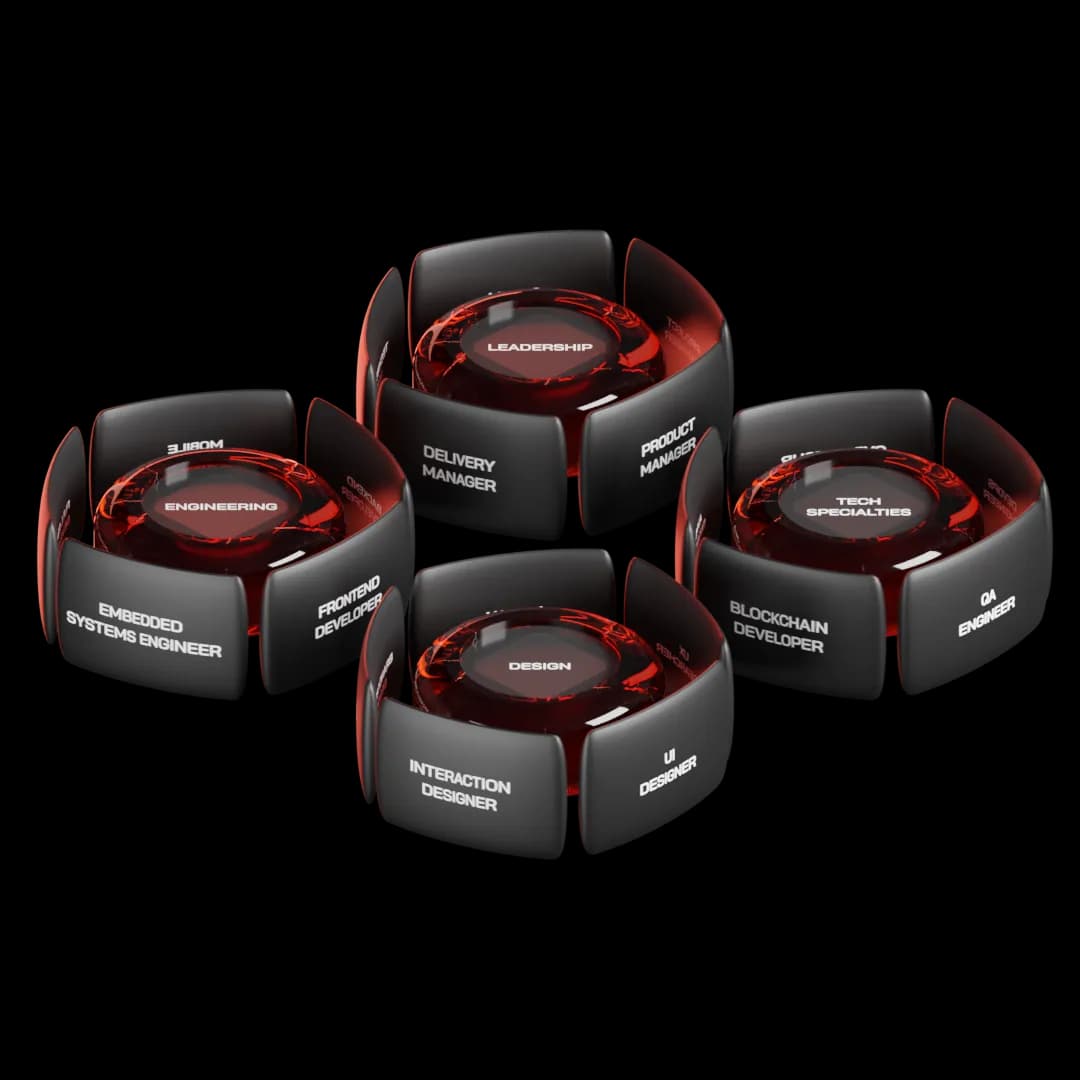
Why teams never go back
This is why companies that adopt this model never go back. It's not simply "faster": it's smarter. It lets you use your energy to build, not to manage.
Modular Engineering Capabilities
Each module represents a capability layer that can be activated independently, while remaining fully integrated into the Red Rock Engineering System.
A product is not built when development starts. It is built when decisions become clear.
01
Module A — Experience Architecture & Pre-Engineering Design
Purpose
Transforms ideas into validated, structured product experiences before any line of code is written.
Includes
UX Designers & Experience Architects
User research, discovery & feasibility analysis
User journeys, experience flows & wireframes
Product logic and interaction architecture
 What it enables
Clear product vision and feasibility validation
Reduced development risk and rework
Alignment between business goals and user experience
 Typical use cases
Early-stage ideas or new products
Founders without a technical team
Complex platforms requiring clarity before execution
This module is often activated as a standalone preliminary phase, or as the strategic foundation before engineering begins.
02
Module B — Engineering Core Activation
Purpose
Activates the foundational engineering system required to build, evolve, and maintain a scalable digital product.
Includes
Senior Software Engineers (Backend, Frontend, Full-Stack)
Cloud-native development teams
AI-augmented engineering workflows
What it enablesFast execution from design to production
High-quality, maintainable codebases
Immediate operational readiness
Typical use casesMVP development
Product acceleration or rebuild
Core platform execution
This module represents the technical backbone of the system.
03
Module C — Architecture & Scalability Intelligence
Purpose
Designs the structural foundations that allow a product to scale safely and efficiently over time.
Includes
Solution & System Architects
Distributed systems and cloud architecture
Performance, scalability & resilience planning
What it enablesLong-term scalability without rewrites
Reduced architectural risk
Infrastructure aligned with growth
Typical use casesProducts expecting rapid user growth
Complex or multi-service platforms
Transition from MVP to scale-up
04
Module D — AI-Augmented Engineering & Automation
Purpose
Introduces artificial intelligence as a leverage layer across development, testing, and optimization.
Includes
AI-assisted coding & refactoring
Intelligent testing & automation pipelines
Productivity and quality acceleration systems
What it enablesHigher output per engineer
Faster delivery cycles
Reduced technical debt
Typical use casesTime-to-market pressure
High-complexity codebases
Organizations seeking execution leverage
05
Module E — DevOps, Reliability & Continuous Delivery
Purpose
Ensures systems remain deployable, observable, and stable as complexity increases.
Includes
CI/CD pipelines & Infrastructure as Code
Automated deployments & cloud operations
Monitoring, observability & reliability practices
What it enablesPredictable, continuous releases
Reduced downtime and operational risk
Scalable operations
Typical use casesProducts with frequent releases
Growing engineering teams
Mission-critical platforms
06
Module F — Product & Technical Governance
Purpose
Aligns engineering execution with business strategy through leadership, standards, and governance.
Includes
Technical leadership & oversight
Engineering governance frameworks
Roadmap alignment and delivery supervision
What it enablesStrategic control over technical decisions
Prevention of chaos and misalignment
Engineering as a long-term asset
Typical use casesMulti-team environments
Founder-led products scaling rapidly
Enterprise innovation units
07
Module G — Cyber Security & Infrastructure Protection
Purpose
Protects systems, data, and users through security-first engineering.
Includes
Cyber Security Engineers & Architects
Secure infrastructure and system design
Threat modeling & vulnerability mitigation
What it enablesReduced exposure to attacks and breaches
Compliance readiness
Trust at scale
Typical use casesSensitive data platforms
Regulated industries
Enterprise-grade products
08
Module H — Quality Assurance & Quality Control
Purpose
Ensures reliability, consistency, and performance across releases.
Includes
QA Engineers & Automation Specialists
Continuous testing pipelines
Release validation & quality governance
What it enablesFewer regressions and failures
Stable user experience
Sustainable development velocity
Typical use casesFrequent releases
Multi-team development
Scale-ups entering maturity
09
Module I — Blockchain & Distributed Systems Engineering
Purpose
Enables decentralized logic, digital assets, and trustless architectures when strategically justified.
Includes
Blockchain Engineers & Smart Contract Developers
Tokenized systems & decentralized architectures
Secure integration with existing platforms
What it enablesOn-chain governance & assets
Trustless system design
New economic models
Typical use casesToken-based platforms
Digital asset ecosystems
Decentralized governance
10
Module J — Metaverse & Immersive Systems Engineering
Purpose
Creates immersive digital environments as a new interaction layer.
Includes
Metaverse & immersive experience engineers
Real-time 3D environments
Integration with AI, blockchain & digital identity
What it enablesTraining, simulation & collaboration
Experience-driven platforms
Digital twins
Typical use casesCorporate training
Innovation labs
Advanced digital experiences
11
Modular Commercial Logic
Module A often comes first — clarity before execution
Module B is the engineering backbone
Other modules are activated progressively
No rigid packages, no fixed menus
You don't buy development. You activate capabilities… in the right order!
The learning effect
Where high-performance teams create high-clarity founders
A side effect many founders don't expect is that, within the first months, they begin to see their business more clearly.
They understand which roles they truly need. They see where time is being wasted. They realize which processes should have been rewritten years ago.
They working with a team that operates with discipline forces you (in a positive way) to bring the same clarity back into your vision. It's like having a professional coach join your gym: they don't just improve your form, they teach you how to understand your own body. Likewise, a high-performance technical team doesn't just accelerate your product; it elevates you, the founder, and your ability to make stronger strategic decisions.
They understand which roles they truly need. They see where time is being wasted. They realize which processes should have been rewritten years ago.
They working with a team that operates with discipline forces you (in a positive way) to bring the same clarity back into your vision. It's like having a professional coach join your gym: they don't just improve your form, they teach you how to understand your own body. Likewise, a high-performance technical team doesn't just accelerate your product; it elevates you, the founder, and your ability to make stronger strategic decisions.
Who this model is really for
Where high-performance teams create high-clarity founders
It's not for:
Those looking to "save money".
Those who want executors to micromanage.
Those trying to outsource the responsibility of the product.
It's for:
Those who want to add muscle to their business.
Those who those who want investors to evaluate them not for the idea, but for their ability to execute it.
Those want their team to move as a single organism, not as isolated individuals.
And above all: it's for those who intend to win the race against time.
Code is workforce
Code is workforce and workforce is power
The conclusion that matters.
In the end, everything comes down to a simple truth: code is workforce — and workforce is power. With Red Rock, you're not hiring engineers.
You're acquiring ready-to-use technical power, structured to scale without limits and fast enough to outrun anyone chasing you. If you want to see what happens when your product finally moves at the same speed as your ambition, you're in the right place.
You're acquiring ready-to-use technical power, structured to scale without limits and fast enough to outrun anyone chasing you. If you want to see what happens when your product finally moves at the same speed as your ambition, you're in the right place.
GET IN TOUCH
Contact Us
 Email
EmailPlease fill out the form on the below, and our team will respond within 24 hours.
Prefer direct contact? You can reach us via email and we'll respond as soon as possible.
contact@redrock.io Location
UAE Office:
UAE, Dubai, Dubai Internet City, Building 2, Third Floor, Premises 310
Open in Google MapsUK Office:
England & Wales at 27 Old Gloucester Street, London, WC1N 3AX
Open in Google MapsGet in touch