
Why the UAE Is Becoming the Global Capita of AI Agents

Red Rock Editorial Team

July 7, 2026

Last Updated on July 7, 2026

10 min read
There is a question every technology executive should be asking in 2026, and almost nobody is asking it correctly. The question is not "which country is leading in artificial intelligence." That conversation is saturated, and the answer is contested. The correct question is narrower and far more consequential: which country is building the conditions for AI agents, autonomous software systems that perceive, decide, and act, to operate at national scale?
The answer is the United Arab Emirates. Not as a slogan, but as a matter of infrastructure, regulation, capital, and political will converging in one place at one time. This article explains why, and what it means for any organization operating in the Gulf.
AI Agents Are Not Chatbots, and the UAE Understands the Difference
Most of the world is still thinking about AI as a conversation. You ask, it answers. AI agents are a different category entirely. An agent is a software system that pursues a goal with autonomy: it reads your inbox, reconciles your invoices, monitors your supply chain, qualifies your leads, and escalates only what requires human judgment. It works while you sleep, and it compounds.
The strategic implication is that agents are not a product you buy once. They are an operational layer that sits on top of a company, or a country. And operational layers require three things that most nations cannot assemble quickly: compute infrastructure, regulatory clarity, and capital patient enough to fund a decade-long build.
The UAE is assembling all three simultaneously.
The Compute Foundation: Stargate UAE and the 5-Gigawatt Campus
Infrastructure is destiny in the agentic era, because every autonomous agent consumes inference around the clock. A chatbot answers when asked. An agent never stops working, which means it never stops consuming compute.
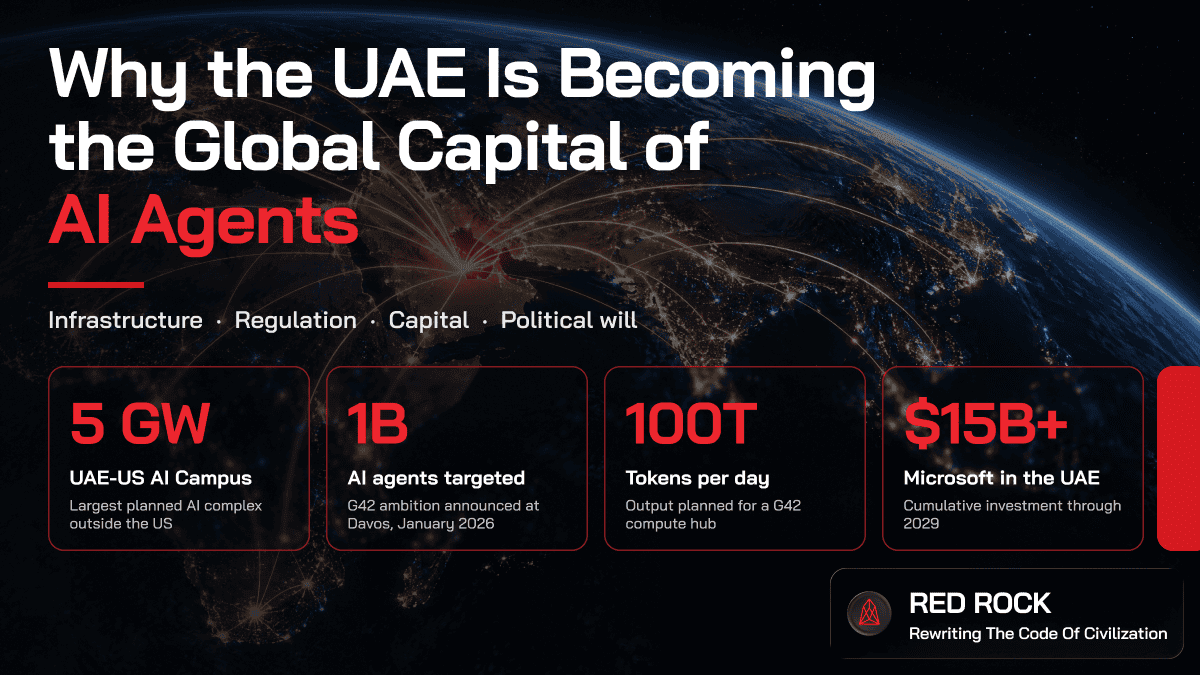
The UAE saw this earlier than almost anyone. In May 2025, G42, OpenAI, Oracle, NVIDIA, Cisco, and SoftBank announced Stargate UAE, a 1-gigawatt AI compute cluster in Abu Dhabi, with the first 200 megawatts scheduled to come online in 2026. It sits inside the larger UAE-US AI Campus, a facility planned to reach 5 gigawatts, positioned to be the largest AI infrastructure complex outside the United States. To calibrate the scale: a typical enterprise data centre in the region runs at 10 to 30 megawatts. The first phase alone is an order of magnitude beyond that.
Alongside this, Microsoft has committed over 15 billion dollars in cumulative UAE investment through 2029 to support AI and cloud infrastructure, following US export approvals for advanced NVIDIA hardware. And G42 has announced plans for a compute hub capable of producing up to 100 trillion tokens per day, explicitly framed not as raw processing but as machine intelligence output.
Read that framing carefully. Tokens per day is the metric of an agent economy, not a chatbot economy. It is the national equivalent of measuring industrial output in kilowatt-hours during electrification.
The Political Signal: One Billion AI Agents
In January 2026, at the World Economic Forum in Davos, G42's chief executive stated a target that most observers underweighted: the ambition to deploy one billion AI agents, spanning roles from petroleum engineering to cybersecurity analysis, as a direct instrument of GDP growth. G42 is simultaneously building what it calls an agent factory, a national framework for creating, orchestrating, and governing autonomous agents across healthcare, education, legal services, and energy, developed in partnership with Microsoft and aligned with national ethical standards.
Whether the number is reached on schedule matters less than what the number reveals. No other country on earth has made agentic AI a stated national KPI. The United States has frontier labs. China has scale. The UAE has made autonomous agents an explicit pillar of economic policy, with sovereign infrastructure to run them and a governance framework to control them.
This is the continuation of a pattern, not a departure from one. The UAE appointed the world's first Minister of State for Artificial Intelligence in 2017. It established the Mohamed bin Zayed University of Artificial Intelligence, the first graduate research university dedicated entirely to AI. Dubai published its Universal Blueprint for Artificial Intelligence and appointed Chief AI Officers across government entities. Vision 2031 places AI at the centre of national economic diversification. The Dubai Future Foundation runs programmes explicitly designed to attract the people who will build this layer. The agentic pivot of 2026 is simply the latest and most decisive move in a nine-year sequence.
The Regulatory Advantage: Clarity as a Competitive Weapon
Here is what enterprise buyers of AI agents actually worry about, and what most commentary ignores: not model capability, but liability, data residency, and legal enforceability. An autonomous system that acts on a company's behalf raises questions a chatbot never does. Who is responsible when an agent executes a flawed transaction? Where does the data live? Under which law is the service contract enforced?
The UAE offers something rare: jurisdictional clarity inside a pro-innovation stance. The DIFC provides an English-language common law framework with a dedicated court system, which makes AI services agreements enforceable in terms international counterparties understand. Free zones such as Dubai Internet City give technology companies operational homes with clear licensing. Sovereign compute means data residency can be guaranteed inside national borders, a decisive factor for government, banking, healthcare, and energy clients.
For an enterprise deploying agents on core operations, this combination, common law contracts plus sovereign infrastructure plus explicit government endorsement of agentic AI, does not exist anywhere else in the world in this configuration.
The Demand Side: An Economy Built for Automation
Infrastructure and regulation are supply. The UAE also has unusual demand-side characteristics that make it the natural first market for AI agents at scale.
The economy is dominated by sectors with high transaction volume and structured workflows: real estate, trade, logistics, financial services, hospitality, and government services. These are precisely the domains where agents produce measurable returns fastest, because the work is procedural, high-frequency, and expensive to staff. A Dubai brokerage managing hundreds of listings, a trading desk monitoring markets around the clock, a government entity processing permits: each is an agent deployment waiting to happen.
Add a structural labour dynamic. The UAE has always imported operational capacity. AI agents are, in economic terms, the next form of imported operational capacity, except they scale without visas, salaries, or attrition. For a nation that has spent five decades converting capital into capability faster than any peer, agents are not a disruption. They are the logical next chapter of the same national strategy.
What Silicon Valley Gets Wrong About This
The prevailing Western narrative treats Gulf AI investment as capital chasing relevance. This misreads the situation in a way that will cost sceptics dearly.
Silicon Valley optimizes for model breakthroughs. The UAE is optimizing for deployment conditions: energy, land, regulatory speed, and state coordination. In the agentic era, deployment conditions are the bottleneck. The frontier models already exist and are increasingly commoditized through APIs. What is scarce is the environment where agents can be put to work on real operations, legally, at scale, with sovereign guarantees. The UAE is not trying to win the model race. It is positioning to own the operating environment, which is where the durable economics of this technology will accrue.
Half the world's population lives within a four-hour flight of the Gulf. An AI hub in Abu Dhabi and Dubai serves the Middle East, Africa, and South Asia, a combined market of roughly three billion people entering the agentic era with no incumbent providers. The UAE is not competing with California for that market. It is the market's default gateway.
What This Means for Your Organization
If you operate in the UAE or the wider GCC, the strategic window is open now, and it will not remain open indefinitely. Early adopters of AI agents in this market gain three compounding advantages: operational cost structures their competitors cannot match, institutional experience with agent governance before it becomes mandatory, and positioning with a government that has made agentic adoption a national priority.
The practical question is no longer whether AI agents will run core business operations in the Gulf. The infrastructure being energized in Abu Dhabi this year settles that. The question is which organizations will be operating on the agentic layer when it becomes the standard, and which will be explaining to their boards why they waited.
At Red Rock Technology, we build and operate AI agent infrastructure for enterprises in the UAE and beyond, from our base in Dubai Internet City, under agreements governed by DIFC law. We made that choice for the same reasons outlined in this article. The global capital of AI agents is being built here. We intend to be part of the reason why.
Next in this series: AI Agents and UAE Vision 2031: The Infrastructure Nobody Is Talking About.
Recent Posts

September 10, 2026
July 7, 2026

May 25, 2026
May 18, 2026

April 26, 2026

 Email
Email Location