
AI Agents for Food Sovereignty: Agriculture Intelligence in the GCC



Red Rock Editorial Team

September 22, 2026

Last Updated on September 22, 2026

8 min read
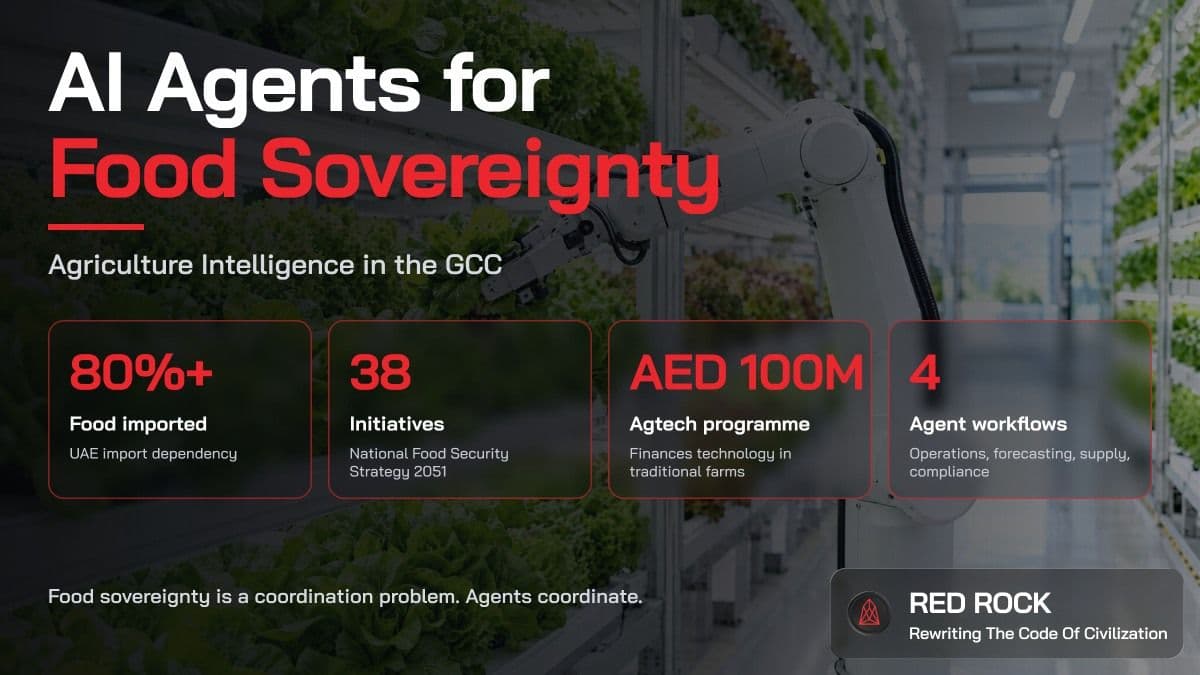
Of all the national priorities in the Gulf, food security is the one where the gap between ambition and physical constraint is widest. The UAE imports the large majority of what it eats, with estimates consistently placing dependency above eighty percent. Arable land is scarce, fresh water is scarcer, and the climate for most of the year is hostile to conventional agriculture. Yet the National Food Security Strategy 2051, launched in November 2018, sets the objective of leading the Global Food Security Index by mid-century, through thirty-eight initiatives spanning domestic production, import diversification with three to five sources for each major food category, and the systematic application of modern technology to food systems.
Most commentary on this strategy focuses on the growing: vertical farms, controlled-environment agriculture, drought-tolerant crops, aquaculture. That focus is correct as far as it goes. But it misses where the largest operational opportunity now sits. Food sovereignty is not only a production problem. It is a coordination problem across a long chain of procurement, monitoring, logistics, compliance, and demand, and coordination problems at continuous volume are precisely what autonomous agents were built to solve.
What Technology Has Already Done, and What It Has Not
The first wave of agricultural technology in the region instrumented the farm. Sensors measure moisture, nutrient concentration, temperature, humidity, and light. Climate control systems adjust conditions in real time. Precision irrigation delivers water with an efficiency conventional agriculture cannot approach. In controlled-environment facilities, which the national strategy has prioritized as a core pillar, the growing environment is now among the most data-rich industrial settings anywhere in the economy. The Ministry of Climate Change and Environment has extended this direction with a AED 100 million programme to finance the adoption of agricultural technology in traditional farms.
What this wave produced is data and dashboards. What it did not produce, in most operations, is autonomous action. A facility manager still reads the alerts, decides the response, adjusts the schedule, contacts the supplier, updates the forecast, and files the compliance record. The instrumentation made the farm observable. It did not make the operation run itself. That is the difference between the previous generation of agricultural technology and the agentic one, and it maps exactly onto the distinction we drew in the article on agents and chatbots: monitoring produces information for a human to act on, agents complete the work.
Four Workflows Where Agents Belong
Facility operations orchestration. A controlled-environment farm generates a continuous stream of sensor readings, equipment states, and scheduled tasks across growing cycles. An agent can operate the loop we described in the article on how agents work: observe the feeds, reason about deviations against defined tolerances, take permitted corrective actions, schedule maintenance when equipment behaviour drifts, and escalate anything outside its mandate to a human with the full context attached. The facility manager moves from reading every alert to reviewing the exceptions that matter, and the operation runs at the same standard at three in the morning as at three in the afternoon.
Yield forecasting and demand matching. Local production only reduces import dependency if what is grown reaches buyers when they need it. Agents can maintain rolling yield forecasts from growth data, reconcile them against commitments to retailers, hospitality groups, and distributors, and adjust planting and harvest schedules to match projected demand. For a sector where perishability makes every mismatch a direct loss, the ability to plan continuously rather than periodically changes the economics of domestic production.
Supply resilience monitoring for importers and distributors. The national strategy's commitment to multiple sources per food category is a monitoring obligation as much as a procurement one. An agent can track supplier performance, shipping conditions, price movements, and disruption signals across every source for every category, flag concentration risk before it becomes exposure, and prepare alternative sourcing options for human decision. The strategy's goal of diversified supply becomes an operating discipline rather than an annual review.
Compliance and traceability. Food moving through the Gulf carries documentation at every step: import approvals, municipality requirements, halal certification, cold chain records, safety inspections, and the traceability data that regulators and large buyers increasingly demand. This is register maintenance and document assembly of exactly the kind we described in the real estate article, and it is the correct first deployment for most operators in the sector: high volume, rule-governed, and currently dependent on human vigilance to avoid lapses.
Governance Where Actions Are Physical
Agriculture introduces a consideration that most enterprise agent deployments do not: some actions have physical consequences. Adjusting a climate setpoint, changing a nutrient dose, or altering an irrigation cycle affects living crops, and errors are not reversible by editing a record.
This makes the action classification framework from our architecture article essential rather than advisable. Routine adjustments within tightly defined bounds may be autonomous. Adjustments approaching those bounds require confirmation. Anything outside them is human-only, and the agent's role is to escalate with evidence, not to improvise. Threshold triggers must be set by agronomists and operations leaders, not inferred by engineers, and the audit trail must be complete, because in a sector tied to national strategic priorities, the ability to demonstrate how decisions were made is part of being a credible operator.
Data residency matters here as well, and for a reason beyond regulatory compliance. Production data, supply chain data, and sourcing intelligence for a nation's food system are strategic information. The sovereign compute capacity we have described across this series exists precisely so that operations of this kind can run advanced systems without exporting the data that describes national resilience.
Why the Gulf Is the Proving Ground
There is a reason to expect agentic agriculture to mature here before it matures in temperate, land-rich economies. Where conditions are forgiving, inefficiency is survivable and the incentive to automate coordination is weak. Where every litre of water, every kilowatt of cooling, and every day of shelf life carries a measurable cost, the operation that coordinates continuously and precisely wins on economics, not on novelty.
The region's constraints therefore function as a forcing mechanism. They demand the level of operational precision that agents deliver, and they are backed by a national strategy, dedicated funding, and the infrastructure and regulatory environment we have set out across this series. Solutions proven under Gulf conditions will be exportable to every arid and import-dependent region in the world, which is a considerable share of it.
Food sovereignty, in the end, will be won less by the facility that grows the most and more by the system that coordinates the most reliably: production, forecasting, sourcing, and compliance operating as one continuously monitored whole. That system is an agentic system, and the Gulf is where it will be built first.
At Red Rock Technology we design, deploy, and operate governed AI agents for enterprises from our base in Dubai Internet City, under agreements governed by DIFC law. Agriculture is a sector where we have a particular interest and where the operational case for agents is unusually clear, because the constraints are physical, the priority is national, and the work is continuous.
Next in this series: AI Agents in Trading Desks: Wyckoff Analysis Meets Machine Precision.
[12:42 PM]
Recent Posts

October 6, 2026
September 22, 2026

September 15, 2026

September 10, 2026

September 8, 2026
Related Posts
October 6, 2026
September 15, 2026
September 10, 2026
September 8, 2026

August 25, 2026
 Email
Email Location