
The Infrastructure Maturity Model: How Companies Become AI-Ready



Red Rock Editorial Team

September 8, 2026

Last Updated on September 8, 2026

10 min read
Nine articles into this series, a pattern has emerged in the questions we receive. Executives no longer ask whether AI agents matter. They ask a more uncomfortable question: are we ready, and if not, what specifically is missing?
That question deserves a structured answer rather than a reassuring one. Most organizations in this market are not ready to deploy autonomous agents on core operations today, and the reasons are rarely about technology or ambition. They are about infrastructure in the broad sense: the state of data, systems, governance, and operating habits that agents depend on to work. The good news is that readiness is a sequence, not a mystery, and every stage of it is buildable.
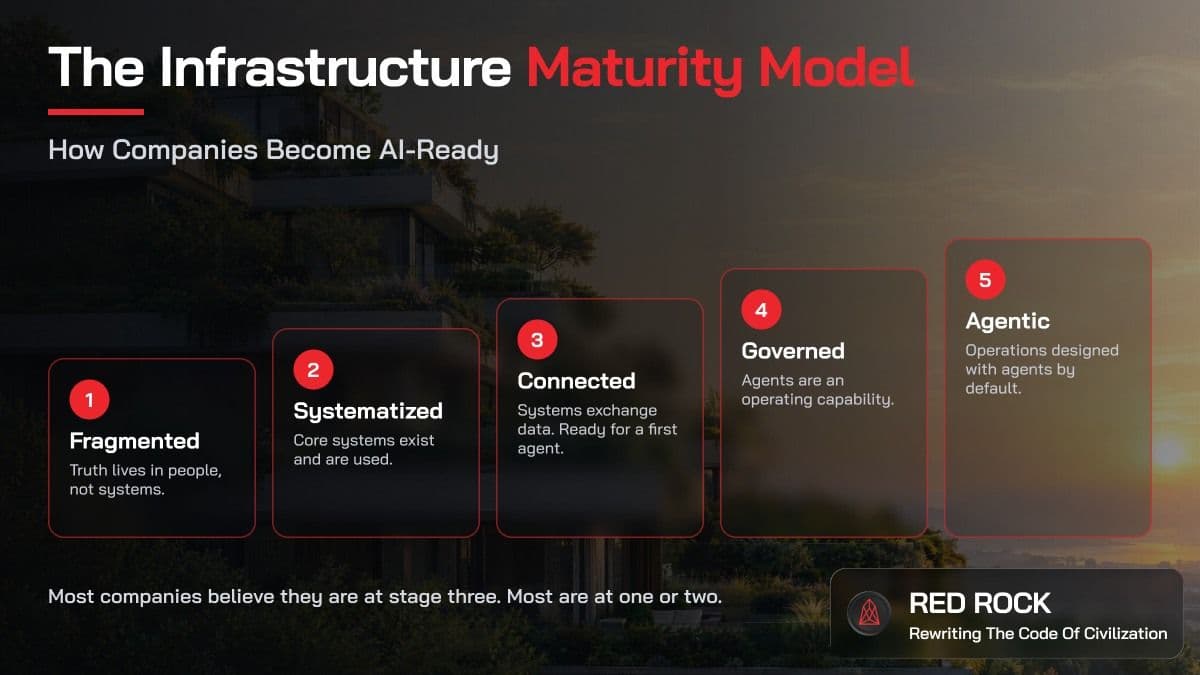
This article sets out the maturity model we use to assess organizations before recommending a single deployment. It has five stages. Most companies we meet are at stage one or two and believe they are at stage three. Knowing your actual position is the first act of readiness.
Stage One: Fragmented
At the first stage, the organization’s operational truth lives in people rather than systems.
Critical information sits in inboxes, personal spreadsheets, message threads, and the memories of long-tenured staff. Processes exist but are not written down, or are written down in a form that no longer matches how work is actually performed. Systems of record exist but are incomplete, inconsistently used, or contradict one another.
Nothing about this stage is a failure. It is how most successful businesses grew, and in the Gulf, where organizations have expanded very quickly and relationships carry enormous weight, it is especially common. But it has one decisive implication for agents, which we set out in the article on how agents actually work: an agent is only as good as what it can retrieve. At stage one, there is very little it can retrieve reliably, and any deployment will surface the fragmentation rather than overcome it.
The work at this stage is not AI work. It is deciding which systems are the source of truth for which facts, consolidating what is scattered, and documenting how processes really run. It is unglamorous, and it produces returns before any agent is switched on, because theorganization discovers where its own information has been failing it.
Stage Two: Systematized
At stage two, the core systems are in place and are actually used. The CRM reflects the pipeline. The finance system reflects the ledger. Documents live in a repository with some structure. Processes are documented well enough that a competent new hire could follow them.
This is the stage at which most organizations believe they are ready for agents, and it is the stage at which most early deployments disappoint. The reason is that systems being in place is not the same as systems being connected. An agent that must act across a workflow needs to move between the CRM, the document store, the communication channel, and the finance system, and at stage two those systems typically do not speak to one another except through human intermediaries copying information between screens.
The work at this stage is integration and data quality. Establishing the interfaces through which systems exchange information, cleaning the data that flows through them, and closing the gaps where a human is currently the only bridge. This is also the point at which the channel reality of this region becomes a design question: if a large share of client communication happens on messaging platforms, those channels must become part of the connected estate, or the agent will be blind to the most important conversations.
Stage Three: Connected
At stage three, the systems exchange information reliably, data quality is measured and maintained, and the organization can trace a piece of work from trigger to completion across systems without a human reconstructing the path. Access rights are defined per system and per role. Logs exist.
This is the true threshold of agent readiness, and the first stage at which we recommend deployment. The work here is the first governed agent on a bounded, high-volume, procedural workflow, with the guardrails described in the article on architecture: scoped permissions, action classification, threshold triggers, a named accountable human, and an escalation path that somebody actually owns.
Companies at this stage make one consistent mistake, which is choosing the first use case for its visibility rather than its suitability. The correct first deployment is boring. It is the reconciliation, the routing, the register maintenance, the recurring report. It proves the operating model, builds the organizational habit of supervising an agent, and generates the audit evidence that later, more visible deployments will need. Ambition belongs at stage four. Stage three is for discipline.
Stage Four: Governed
At stage four, several agents are in production, each with a documented mandate, a named owner, a review cadence, and an audit trail that can reconstruct any action. The organization has a defined process for proposing, approving, deploying, and retiring agents.
Someone is accountable for the agent estate as a whole, which in the DIFC now has a formal name under Regulation 10, and elsewhere should have one anyway.
The characteristic of this stage is that agents have become an operating capability rather than a series of projects. Business owners propose use cases in the language of outcomes and hours returned, not in the language of technology. The evaluation framework has shifted from interaction metrics to outcome metrics, the distinction we drew in the article on agents and the bottom line. And critically, the organization has learned to expand mandates gradually: an agent that has performed reliably under confirm-before-execute for a quarter earns autonomy on that action class, and the decision is recorded.
The work at this stage is portfolio management. Deciding where the next agents create the most value, retiring those that no longer justify their compute, and continuously tightening the governance so that scale does not erode control.
Stage Five: Agentic
At the final stage, the organization designs its operations with agents as a default participant. New processes are specified with the question of what the agent does and what the human does answered at inception. Capacity planning includes inference as an industrial input, budgeted against output and secured where regulators require it to reside.
Senior people spend their time on the decisions that require them, because the procedural layer beneath them runs continuously.
Very few organizations anywhere are at stage five today. In this market, the ones that arrive first will enjoy a structural cost and capacity position that competitors cannot replicate quickly, for the reasons set out across this entire series: the infrastructure, regulation, and policy of the UAE are being tooled for exactly this operating model, and the national vision assumes it.
How to Use the Model
Three practical rules for applying the model honestly.
First, assess by evidence, not by intention. The question is not whether you have a CRM but whether the CRM is the source of truth and whether other systems can read it. Ask for the trace of a real piece of work across systems. The trace tells you the stage.Second, do not skip stages. Organizations that deploy agents at stage one or two do not accelerate their readiness. They generate a failed pilot and a cautious executive, the failure pattern we described in the GCC article. The fastest route to stage four runs through stages two and three, done properly.
Third, treat the early stages as value-creating in their own right. Consolidating truth and connecting systems improves any organization, with or without agents. Companies that approach readiness as a cost to be endured before the interesting part begins consistently underinvest in the work that determines whether the interesting part succeeds.
Readiness, in the end, is not a technology posture. It is an operating discipline, and it is the same discipline that makes an organization trustworthy to regulators, counterparties, and its own board. Which is why, in this market above all, it pays twice.
At Red Rock Technology we design, deploy, and operate governed AI agents for enterprises from our base in Dubai Internet City, under agreements governed by DIFC law. Every engagement begins with this assessment, and we will tell an organization it is not ready before we will sell it a deployment. That is not caution. It is how deployments succeed.
Next in this series: AI Agents in Real Estate: How Dubai Brokerages Are Automating Operations.
Recent Posts

October 6, 2026

September 22, 2026

September 15, 2026

September 10, 2026
September 8, 2026
Related Posts
October 6, 2026
September 22, 2026
September 15, 2026

August 25, 2026

August 18, 2026
 Email
Email Location