
AI Agents in Real Estate: How Dubai Brokerages Are Automating Operations



Red Rock Editorial Team

September 15, 2026

Last Updated on September 15, 2026

9 min read
The first ten articles in this series built the argument in general terms: what agents are, why the UAE is the natural environment for them, how they should be governed, and how organizations become ready. This article begins the third arc, in which we apply that framework to specific sectors. We start with the one that most visibly defines Dubai's economy and most obviously strains under its own success.
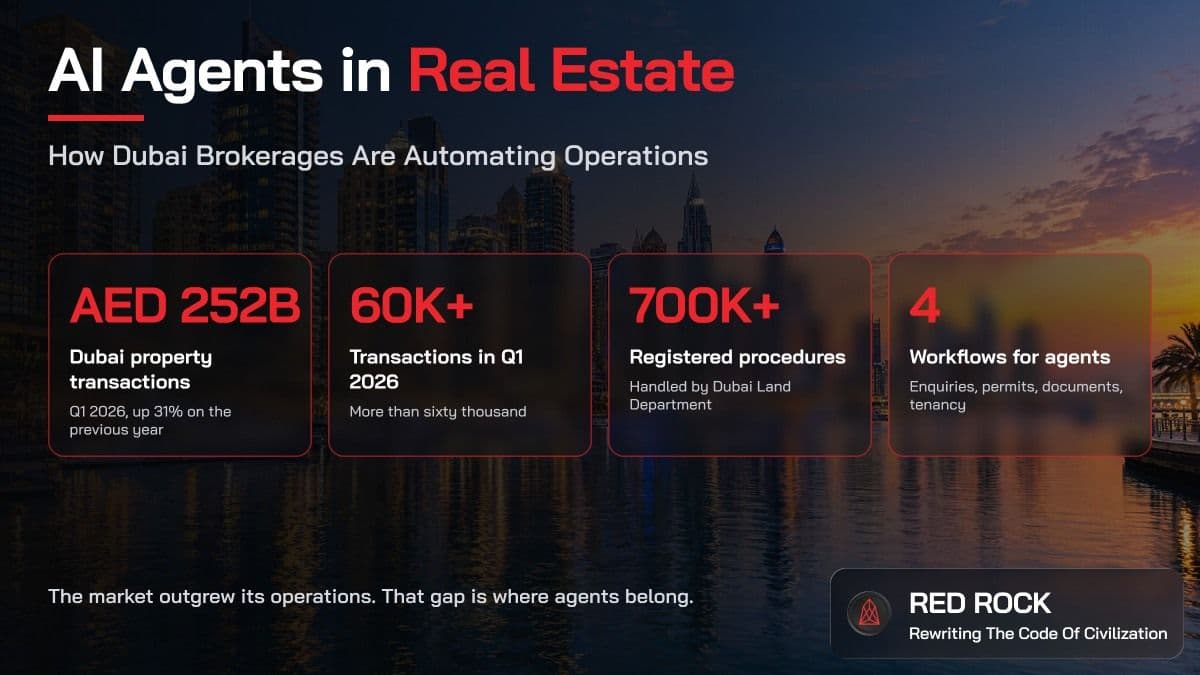
In the first quarter of 2026 alone, Dubai Land Department recorded real estate transactions worth AED 252 billion, up thirty-one percent on the previous year, across more than sixty thousand transactions and over seven hundred thousand registered procedures. Behind each of those numbers sits a chain of human work: enquiries answered, viewings arranged, documents assembled, permits obtained, forms completed, payments tracked, handovers coordinated. The market has grown far faster than the operational methods used to serve it. That gap is where agents belong.
The Brokerage Arithmetic
Consider the economics of a mid-sized Dubai brokerage honestly. Revenue is commission on closed transactions. Cost is overwhelmingly people: agents on commission structures, plus the administrative, marketing, and coordination staff who keep the machine running. The binding constraint on growth is not demand. It is the number of qualified conversations a team can hold, the speed with which it can respond, and the volume of procedural work each transaction generates before commission is earned.
Three characteristics of this market make the constraint unusually severe. Enquiries arrive around the clock, from every time zone, because Dubai's buyer base is global. A large share of them arrive on messaging channels rather than through forms or email, the channel reality we described in the GCC article. And the regulatory framework, precisely because it is well built, generates documentation at every step: advertising permits, standardized agency and sale agreements, tenancy registration, developer and project verification, and the procedures of the Land Department itself.
The result is a business in which highly paid, relationship-driven professionals spend a substantial part of their working lives on procedure. That is the exact profile of work the agentic layer was built for.
Four Workflows Where Agents Change the Model
Enquiry qualification and routing. A serious buyer messaging at two in the morning from another continent expects an answer that reflects the property, their budget, and their timeline, not an acknowledgement and a wait until office hours. An agent operating natively on messaging channels can hold that first qualifying conversation, in English or Arabic, confirm intent and parameters, verify basic details against the listing data, propose viewing slots against the team's real calendar, and route the qualified lead to the right human with full context attached. What reaches the broker is not a message but a briefed opportunity. Response time collapses, and the human's first interaction begins at the point of value rather than the point of triage.
Listing compliance and permit management. Every advertised property in Dubai must carry a valid advertising permit issued through the regulator's system, tied to a specific listing and a specific authorization from the owner. Brokerages managing hundreds of active listings manage hundreds of permits, expiry dates, and owner authorizations, and the penalties for lapses are real. An agent can maintain that register continuously: tracking permit status, flagging approaching expiries, verifying that live advertisements match permitted details, and escalating the exceptions. This is register maintenance, the boring and correct first deployment we recommended in the maturity model article, and it removes a category of compliance risk that currently depends on human vigilance.
Transaction document assembly. From the standardized agency agreements through the sale contract to the Land Department's own registration procedures, a transaction generates a predictable set of documents populated from a predictable set of facts: parties, property, price, terms, dates. An agent can assemble drafts from verified source data, check them for internal consistency, confirm that required fields and attachments are present, and prepare the package for human review and signature. The human still reviews and signs. What disappears is the hours of preparation, and with them a large share of the transcription errors that delay registrations.
Property management and tenancy operations. For firms managing portfolios, the recurring work is relentless: tenancy registrations and renewals, payment tracking against schedules, maintenance requests triaged and dispatched, notices issued at contractually defined intervals. Each of these is procedural, calendar-driven, and rule-governed. Agents maintaining these cycles continuously convert property management from a reactive function into a monitored one, where humans intervene on exceptions rather than on everything.
Governance in a Regulated Market
Real estate in Dubai is a regulated activity, and that is a reason to deploy agents carefully, not a reason to avoid them. Three considerations determine whether a deployment is defensible.
The first is the boundary of autonomy. An agent may prepare a contract; a licensed professional signs it. An agent may qualify an enquiry; a registered broker conducts the transaction. The action classification we described in the architecture article, autonomous, confirm-before-execute, human-only, maps naturally onto the regulator's own distinction between administrative work and licensed activity. Designed correctly, the agent never performs a regulated act. It removes everything around it.
The second is data. Brokerages hold personal and financial data on buyers, sellers, landlords, and tenants, much of it from outside the UAE. The federal data protection law's rules on lawful basis and cross-border transfer, which we examined in the regulation article, apply directly, and an agent that routes client data to a foreign model endpoint for inference has created a compliance exposure the firm may not have noticed. Residency is an architecture decision, and in this sector it should be made deliberately.
The third is auditability. When a dispute arises, and in a market of this volume disputes arise, the ability to reconstruct exactly what the agent did, on what data, and who approved it is not a technical nicety. It is the difference between a firm that can defend its process and one that cannot.
What Changes Competitively
The brokerages that deploy governed agents on these four workflows do not merely become more efficient. They change their unit economics. The same team holds more qualified conversations, closes with fewer procedural delays, carries less compliance risk, and manages larger portfolios without proportional headcount. Their best people spend their time where commission is actually earned: with clients, on the relationship, at the negotiation.
The firms that do not will compete against that cost structure with the old one. In a market growing at thirty percent a year, the gap between the two compounds quickly, and it compounds in a direction the late movers will find difficult to reverse.
None of this requires replacing the broker. The broker is the point of the business. It requires removing from the broker's day everything that is not brokering, which is exactly what the technology, deployed under proper governance, is able to do.
At Red Rock Technology we design, deploy, and operate governed AI agents for enterprises from our base in Dubai Internet City, under agreements governed by DIFC law. Real estate is where the operational arithmetic of this market is most visible, and it is where we see the framework set out across this series produce results fastest.
Next in this series: AI Agents for Food Sovereignty: Agriculture Intelligence in the GCC.
Recent Posts

October 6, 2026

September 22, 2026
September 15, 2026

September 10, 2026

September 8, 2026
Related Posts
October 6, 2026
September 22, 2026
September 8, 2026

August 25, 2026

August 18, 2026
 Email
Email Location