
The Subscription Model for AI Operations: Why Ownership Is Obsolete


Red Rock Editorial Team

October 6, 2026

Last Updated on October 6, 2026

9 min read
Every technology wave produces the same instinct in serious organizations: if this matters, we should own it. Build the team, buy the hardware, control the stack. It is a respectable instinct, and in the era of enterprise software it was often correct. Applied to AI agents, it is the most expensive mistake an organization in this market can currently make.
This article explains why ownership of agentic infrastructure has become a liability rather than an asset, what the alternative actually consists of, and, because the argument should be honest, where ownership still makes sense. The conclusion is not that companies should care less about this technology. It is that caring about it correctly means buying outcomes and governance, not accumulating assets that depreciate on someone else’s schedule.
Three Reasons Ownership Has Inverted
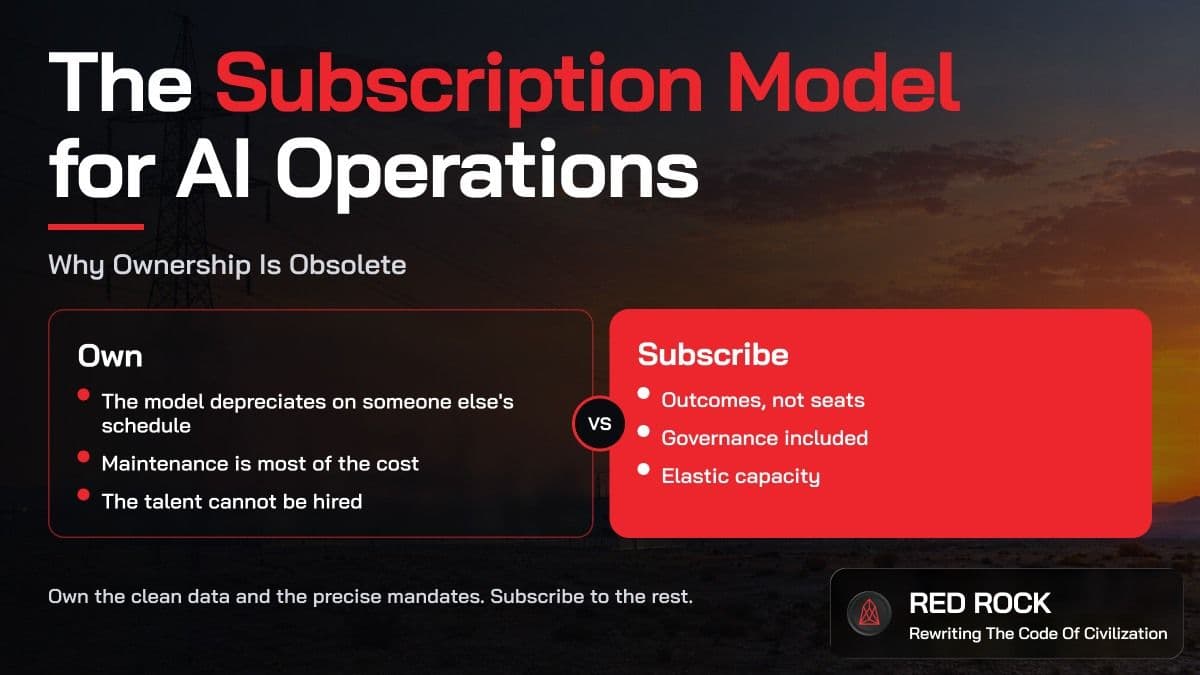
The model is not the asset. We argued in the article on architecture that the reasoning model is the least strategically important component of an agent, and the argument has a financial corollary. Models improve, cheapen, and are replaced on a cadence set by frontier laboratories, not by the enterprise that adopted them. An organization that builds around a specific model has acquired a depreciating dependency. An operated service that swaps models beneath a stable agent architecture converts that depreciation into someone else’s problem, and passes the improvement through as a matter of course.
Maintenance is the majority of the cost. The demonstration is the cheap part. What follows is continuous: integrations break when upstream systems change, data drifts, prompts and criteria require tuning as the business evolves, guardrails need revision as mandates expand, models need re-evaluation on every release, and the audit trail must be maintained and reviewed. We described this review cadence in the article on the maturity model, and it is not optional. An organization that owns its agents owns all of this, forever, with a team it must recruit, retain, and keep current in a field that reinvents itself every few months.
The talent does not scale to every company. The people who can design, govern, and operate production agents are scarce everywhere and acutely scarce in this region, where every national programme, sovereign entity, and global technology firm is competing for the same individuals. A mid-sized enterprise cannot realistically hire and hold a team capable of running this discipline in-house. It can, however, subscribe to one, which is the subject of the next article in this series.
Put the three together and the ownership case dissolves. The asset depreciates, the maintenance dominates, and the people cannot be hired. This is the situation the cloud resolved for computing infrastructure a decade ago, and the parallel is exact: nobody serious argues today for owning their own data centre to run email.
What a Subscription Actually Buys
It is worth being precise, because the phrase “AI subscription” is used loosely and much of what it describes is worthless. A subscription to a chatbot licence is a software purchase. A subscription to agentic operations is something structurally different: an operated capability, priced against the work it performs, with governance included.
Four components define it. Outcomes, not seats: the unit of value is workflows completed, exceptions correctly escalated, and hours returned to named senior roles, the metrics we set out in the article on agents and the bottom line. Pricing that follows outcomes aligns the provider’s incentive with the client’s, which seat-based licensing never did. Continuous operation: the loop runs, the integrations are maintained, the models are evaluated and swapped, and the client is not asked to care which model is in use this quarter. Governance as part of the service: documented mandates, action classification, audit trails, review cadence, and a named accountable human on the provider’s side who works with the client’s own accountable owner. In the DIFC, this arrangement must map onto the Regulation 10 requirements we described in the regulation article, and a serious provider will show you how it does. Elasticity: capacity that rises with volume and falls with it, converting a fixed operating structure into a variable one, which in the cyclical economy of the Gulf is worth more than most balance sheets currently recognize.
This is the operating model the region has always understood. The Gulf did not become a global logistics and financial hub by owning every capability. It subscribed to the world’s best, on its own terms, inside jurisdictions it controlled. Agentic operations are the same model applied to a new input.
The Honest Exceptions
Ownership is not obsolete in every case, and a provider who claims otherwise should be trusted less, not more.
It makes sense where the agent’s logic is itself the company’s core intellectual property, such that describing the mandate to any third party would surrender the business. It makes sense for a small number of sovereign, defence, and critical-infrastructure contexts where policy requires internal control regardless of cost. And it may make sense for very large organizations with the scale to sustain a genuine internal capability, though even there, the pattern that works is a small internal governance function directing operated services rather than a large internal build.
The test is simple. If the agent is the product, consider owning it. If the agent runs the operations behind the product, subscribe.
What to Demand Before You Sign
The subscription model transfers operational burden, not accountability. The client remains responsible for what happens in its business, and the contract must reflect that. Five terms separate a defensible subscription from a dependency.
Data ownership: every record, log, embedding, and output belongs to the client, without qualification. Residency: prompts, logs, and stored context reside where the client’s regulators require, and the location is specified in writing. Auditability: the client can reconstruct any action the agent took, at any time, without the provider’s cooperation being a precondition. Exit: documented mandates, integration specifications, and full data return on termination, so that the capability can be moved rather than lost. And governing law: an agreement enforceable in a jurisdiction the client’s board and counsel already trust, which in this market means the common law framework of the DIFC.
A provider who agrees readily to all five has built the service to be trusted. A provider who resists any of them has built it to be sticky, which is not the same thing.
The Shift in What Is Owned
The deepest change in this model is not financial. It is a change in what an organization considers worth owning. In the era of software, companies owned licences, servers, and code. In the era of agents, the assets that matter are different: clean systems of record, well-documented processes, precise mandates, and the institutional habit of supervising autonomous systems well. Those are the things a subscription cannot supply and a competitor cannot copy, and they are exactly the things we described as the early stages of readiness in the maturity model.
Own those. Subscribe to the rest. That allocation is how organizations in this market will build agentic capability at a pace and cost that ownership could never match, and it is the model the region’s own history recommends.
At Red Rock Technology we design, deploy, and operate governed AI agents for enterprises from our base in Dubai Internet City, under agreements governed by DIFC law. We built the company as an operated service on the five terms above because we believe they are the terms a serious client should insist on, and we would rather compete on how well we meet them than on how difficult we make it to leave.
Next in this series: Building an AI Operations Function Without Hiring a Single Engineer.
Recent Posts
October 6, 2026

September 22, 2026

September 15, 2026

September 10, 2026

September 8, 2026
Related Posts
September 22, 2026
September 15, 2026
September 8, 2026

August 25, 2026

August 18, 2026
 Email
Email Location