
Building an AI Operations Function Without Hiring a Single Engineer



Red Rock Editorial Team

October 13, 2026

Last Updated on October 13, 2026

9 min read
The previous article argued that ownership of agentic infrastructure has inverted into a liability. The natural objection arrived quickly, and it is the right one: if we do not build the team, who inside our organization actually runs this? A capability that nobody owns internally is not a capability. It is a vendor relationship that will drift the moment attention moves elsewhere.
The objection is correct, and the answer to it is not what most executives expect. The function an organization must build is real, it is small, and it contains no engineers. What it contains is judgment, ownership, and operating discipline, applied by people the organization very likely already employs. This article describes that function: the roles, the rhythm, and the mistakes that reliably undermine it.
The Function Is Governance, Not Engineering
Begin with what the operated model, described in the previous article, removes from the organization’s plate. Model selection, integration maintenance, prompt and criteria engineering, infrastructure, monitoring, and the technical half of the audit trail all sit with the provider. What remains with the client is everything that cannot be delegated because it constitutes the business itself: deciding what the agents should do, on which data, within what limits, supervised by whom, and reviewed how often.
That is a governance function. It is the same discipline any organization applies to delegated human authority, expressed for software, as we set out in the article on architecture. And governance is performed by people who understand the business, not by people who understand the code. Hiring engineers to run it is the equivalent of hiring mechanics to manage a logistics company. The mechanics matter. They are not who decides where the trucks go.
The Four Roles
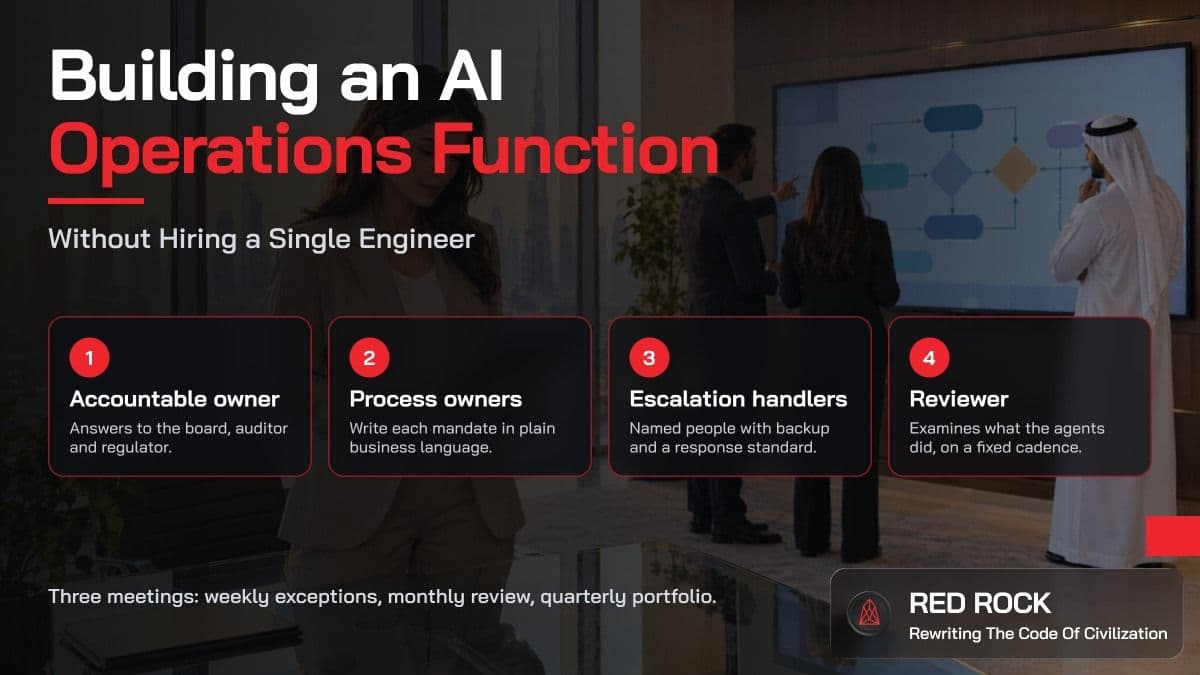
In practice, a working AI operations function consists of four roles. In a mid-sized organization these are responsibilities added to existing people, not new positions. In a large one they may become dedicated, but the shape is identical.
The accountable owner. One senior person owns the agent estate as a whole: its mandates, its risk, and its results. In the DIFC, this role now has formal expression as the Autonomous Systems Officer under Regulation 10, as we described in the article on regulation; elsewhere it should exist regardless. The owner is not the person who knows the most about AI. It is the person who can answer to the board, the auditor, and the regulator for what the agents did, and who has the authority to stop any of them. In most organizations this is a chief operating officer, a chief risk officer, or their direct deputy.
The process owners. For every agent, one business person owns the workflow it runs. They write the mandate in the language of the article that defined agents: what the agent does, on which data, with which permissions, and what it is forbidden to do. They classify actions into autonomous, confirm-before-execute, and human-only. They set the thresholds. They are the ones who know that a certain exception always needs a phone call, and that a certain document is unreliable, and that a certain client must never receive an automated message. The provider builds what the process owner specifies. The process owner cannot be outsourced, because their knowledge is the business.
The escalation handlers. When an agent stops and asks, someone must answer, with authority and within a defined time. We argued in the architecture article that deployments fail on this point more than on any technical one: escalations landing in a queue nobody owns, until the team either ignores the agent or approves everything unread. The escalation handlers are named individuals with backup coverage, a response standard, and the context to decide. They are usually the most experienced operators in the relevant team, and their time is the scarcest resource the function consumes, which is why the mandate and thresholds must be designed to escalate rarely and precisely.
The reviewer. On a fixed cadence, someone examines what the agents did: what they completed, what they escalated, what they got wrong, and whether each mandate should expand, contract, or be retired. This review is where the function learns. An agent that has performed reliably under confirmation for a quarter earns autonomy on that action class, and the decision is recorded. An agent whose escalations reveal a broken upstream process triggers a fix to the process, not a patch to the agent. In many organizations the reviewer is the accountable owner or an internal audit function, and the review is a standing item on an existing operations meeting.
The Rhythm
The function runs on a simple cadence that maps to disciplines most organizations already have.
Weekly, the escalation handlers and process owners review the exceptions: volume, pattern, and any case that suggests a mandate is wrong. Monthly, the reviewer examines performance against the outcome metrics from the article on agents and the bottom line, workflows completed, exceptions correctly escalated, error rate against the human baseline, hours returned to named roles. Quarterly, the accountable owner reviews the estate as a portfolio with the provider: which agents justify their compute, which mandates should change, where the next deployment creates the most value, and whether governance is keeping pace with scale.
That is the entire rhythm. Three meetings, each of which can attach to a meeting that already exists. The function’s cost is measured in hours of existing people’s attention, and a well-designed estate returns many times those hours to the same people.
The Mistakes That Undermine It
Four failures recur often enough to name.
Assigning ownership to IT. The technology department is a natural partner and the wrong owner. Agents run business processes, carry business risk, and are judged on business outcomes. Owned by IT, they become a technology project, evaluated with technology metrics, and disconnected from the process owners whose knowledge makes them work.
Writing mandates in the provider’s language. If the process owner cannot explain the agent’s mandate to a colleague without technical vocabulary, the mandate is not the process owner’s. Mandates belong in plain business language, because that is the language in which they will be defended to a board or a regulator.
Treating escalation as an inconvenience. Organizations that respond to frequent escalations by loosening thresholds have replaced governance with convenience. The correct response is to examine why the agent is escalating, which usually reveals a data problem or a process ambiguity that was always there and is now visible.
Skipping the review. An unreviewed agent estate drifts, and drift is silent. The monthly review is the single practice that separates organizations at stage four of the maturity model from those that believe they are there.
Why This Is Achievable Here
Everything above assumes an organization willing to apply ordinary operating discipline to a new kind of delegated authority. That is a lower bar than building a technical team, and it is a bar this region’s organizations are well placed to clear. Authority is concentrated, decisions are taken at the top, and sponsorship from the principal, which we identified in the GCC article as the precondition for any successful deployment, is the same sponsorship that makes an accountable owner effective.
The organizations that will lead in agentic operations in this market are not those with the largest technical teams. They are those with the clearest mandates, the most disciplined escalation, and the most consistent review. None of that requires an engineer. All of it requires ownership.
At Red Rock Technology we design, deploy, and operate governed AI agents for enterprises from our base in Dubai Internet City, under agreements governed by DIFC law. Every engagement we take on establishes the four roles above on the client side before the first agent goes live, because an operated service without a governing function on the other side is not a partnership. It is a risk we decline to create.
Next in this series: The Next 24 Months: AI Agents Predictions for the UAE Market.
Message Jane
Recent Posts

October 17, 2026
October 13, 2026

October 6, 2026

September 22, 2026

September 15, 2026
Related Posts
October 6, 2026
September 22, 2026
September 15, 2026

September 8, 2026

August 25, 2026
 Email
 Location