
The Anatomy of an Enterprise AI Agent: Architecture, Guardrails, Governance



Red Rock Editorial Team

August 18, 2026

Last Updated on August 18, 2026

9 min read
Every AI agent demonstration looks the same. A prompt goes in, the system takes a series of impressive actions, the work completes, the room is satisfied. What the demonstration never shows is the part that determines whether the system survives contact with a real enterprise: what happens when the input is malformed, when the underlying system is unavailable, when the agent encounters a case its designers never imagined, and when a regulator asks who authorized a specific action taken at three in the morning.
The distance between a demonstration and a production system is almost entirely made of those answers. This article opens the machine and describes what an enterprise-grade agent is actually made of. It is written for executives who must evaluate a proposal rather than write the code, because the questions below are the ones that separate a vendor who has deployed in regulated environments from one who has not.
The Six Components
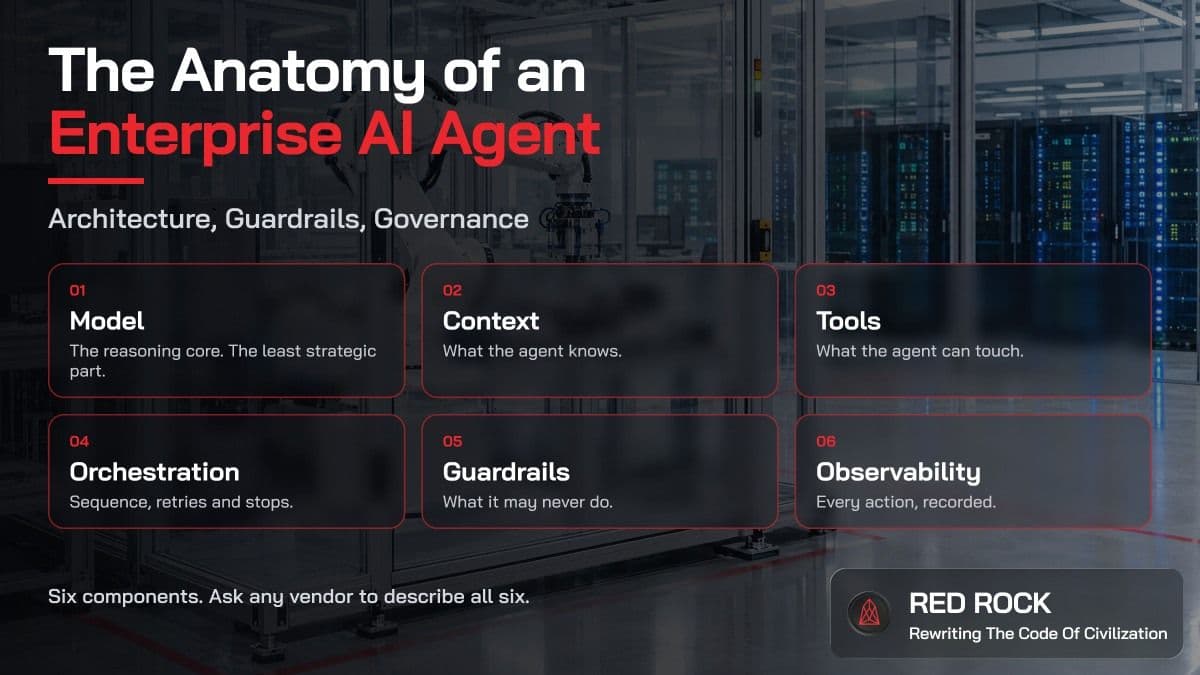
Strip any serious agent to its structure and six components appear. Each one is a place where deployments succeed or fail.
The model is the reasoning core. It is also the least strategically important component, and treating it as the centre of the decision is the most common evaluation error we encounter.
Models are increasingly interchangeable, improve on someone else’s schedule, and in this region may need to be Arabic-native for the reasons set out in the previous article. A well- built agent can change its model without redesign. If a vendor’s differentiation is which model they use, they have no differentiation.
The context layer is what the agent knows. Retrieval systems, document stores, embeddings, and connections to the systems of record where truth actually lives. This is where most quality problems originate. An agent reasoning brilliantly over stale, partial, or badly structured context produces confident errors, which are worse than obvious ones.
The tools are what the agent can touch. Every integration into a CRM, an ERP, a mailbox, a payment system, a document repository. Tools convert reasoning into effect, and each one is also an attack surface and a liability boundary. The scoping of tools is the single most consequential security decision in a deployment.The orchestration layer decides sequence: which steps run in what order, what happens on failure, when to retry, when to stop. Real workflows are not linear, and orchestration is where the difference between a script and an agent becomes visible.
The guardrail layer constrains behaviour. It defines what the agent may never do, what requires confirmation, what thresholds trigger escalation, and what inputs must be rejected.
We return to this below, because it is where enterprise-grade systems separate from prototypes.
The observability layer records everything. Every decision, every tool call, every input and output, with timestamps and lineage. Without it, the agent is unauditable, and an unauditable agent cannot be deployed in any regulated sector in this market.
A useful diagnostic when reviewing any proposal: ask the vendor to describe all six. Vendors who have shipped into production discuss guardrails and observability without prompting.
Vendors who have not will talk about the model.
Guardrails Are the Product
Autonomy without constraint is not a capability, it is exposure. And the constraints that matter in enterprise deployment fall into four categories.
Permission scoping. The agent holds exactly the access it needs and nothing more, with credentials distinct from any human’s. When a finance agent needs to read invoices and write reconciliation notes, it does not receive the ability to issue payments because the same system happens to offer it.
Action classification. Every action the agent can take is sorted in advance into three tiers: autonomous, confirm-before-execute, and human-only. This classification is a business decision, not a technical one, and it should be made by the process owner and signed off, not inferred by engineers.
Threshold triggers. Value limits, volume limits, and confidence limits that force escalation.
An agent processing routine claims autonomously should stop and ask when the amount, the anomaly score, or its own uncertainty crosses a defined line.
Input validation and rejection. Production agents encounter malformed documents, contradictory instructions, and occasionally deliberate attempts to manipulate them through the content they process. A system that cannot recognize and refuse a bad input is a system that will eventually act on one.
The design principle underneath all four is that a good agent fails safely. It stops, escalates with full context attached, and waits. That is the behaviour to test for in a pilot, and almost nobody tests for it: give the system the awkward case, the incomplete file, the request justoutside its mandate, and watch what it does. A system that improvises confidently in an edge case will improvise confidently in production.
Governance: The Layer Above the Software
Guardrails are technical. Governance is organizational, and it is what a board, an auditor, or a regulator will actually examine.
Four elements constitute it. Accountability: a named human owns each agent’s behaviour.
In the DIFC, as covered in article three, Regulation 10 has formalized this with the Autonomous Systems Officer role, but the principle applies regardless of jurisdiction.
Ownership sits with a person, not a department.
Documented mandate: a written scope stating what the agent does, on which data, with which permissions, and what it is explicitly forbidden to do. This is the job description we discussed in article four, and it exists so that the answer to “who authorized this” is a document rather than a recollection.
Audit trail: the observability layer, retained and reviewable. If an action cannot be reconstructed months later, it cannot be defended.
Review cadence: scheduled examination of what the agent did, what it escalated, what it got wrong, and whether its mandate should expand or contract. Agents drift as the systems and data around them change. Unreviewed agents do not stay correct.
None of this is exotic. It is the ordinary governance any organization applies to a person with delegated authority, expressed in a form appropriate to software. Companies that already have strong operational governance find this straightforward. Companies that do not discover their agent project has exposed a pre-existing gap.
The Human Layer
One component sits outside the software and determines more than any of the six above: the escalation path.
When an agent stops and asks, someone must be there to answer, with the authority and the context to decide. Deployments fail more often on this than on any technical dimension.
The agent works, escalates correctly, and the escalation lands in a queue nobody owns.
Within weeks the team is either ignoring the agent or approving everything without reading it, which is the same as having no guardrails at all while retaining the paperwork that says otherwise.
The design question is therefore not only what the agent does. It is who receives what itcannot do, how quickly, and with what authority. That is an operating model decision, and it belongs in the deployment plan from the first week.
What to Ask Before You Sign
Six questions, drawn from everything above, that will tell you more about a vendor than any demonstration.
Which actions are autonomous, which require confirmation, and who classified them? What does the system do when it encounters an input it does not understand? Who is the named human accountable for this agent’s behaviour? Can you reconstruct any action taken six months ago, with its inputs and reasoning? What happens to this deployment if we change the underlying model? And where do prompts, logs, and embeddings physically reside? A vendor who answers all six precisely has built for production. A vendor who redirects to model capabilities has built a demonstration.
At Red Rock Technology we design, deploy, and operate governed AI agents for enterprises from our base in Dubai Internet City, under agreements governed by DIFC law. We wrote this article as the specification we hold ourselves to, and we would encourage any organization evaluating this technology to hold every vendor, including us, to exactly these questions.
Next in this series: How AI Agents Actually Work: Beyond the Hype, Into the Infrastructure.
Recent Posts

October 6, 2026

September 22, 2026

September 15, 2026

September 10, 2026

September 8, 2026
Related Posts
October 6, 2026
September 22, 2026
September 15, 2026
September 8, 2026

August 25, 2026
 Email
Email Location