
AI Agents and UAE Vision 2031: The Infrastructure Nobody Is Talking About



Red Rock Editorial Team

July 14, 2026

Last Updated on July 14, 2026

5 min read
And at the emirate level, Dubai has translated the national strategy into municipal machinery: the Universal Blueprint for Artificial Intelligence, Chief AI Officers appointed across government entities, and the Dubai Future Foundation systematically recruiting the entrepreneurs and specialists who will build this layer. Very few observers have connected these appointments to the vision's arithmetic. Every Chief AI Officer is, in practice, a future buyer and governor of agent deployments inside their entity.
The Demographic Equation
Here is the analysis you will not find in the promotional material, and it is the heart of the matter.
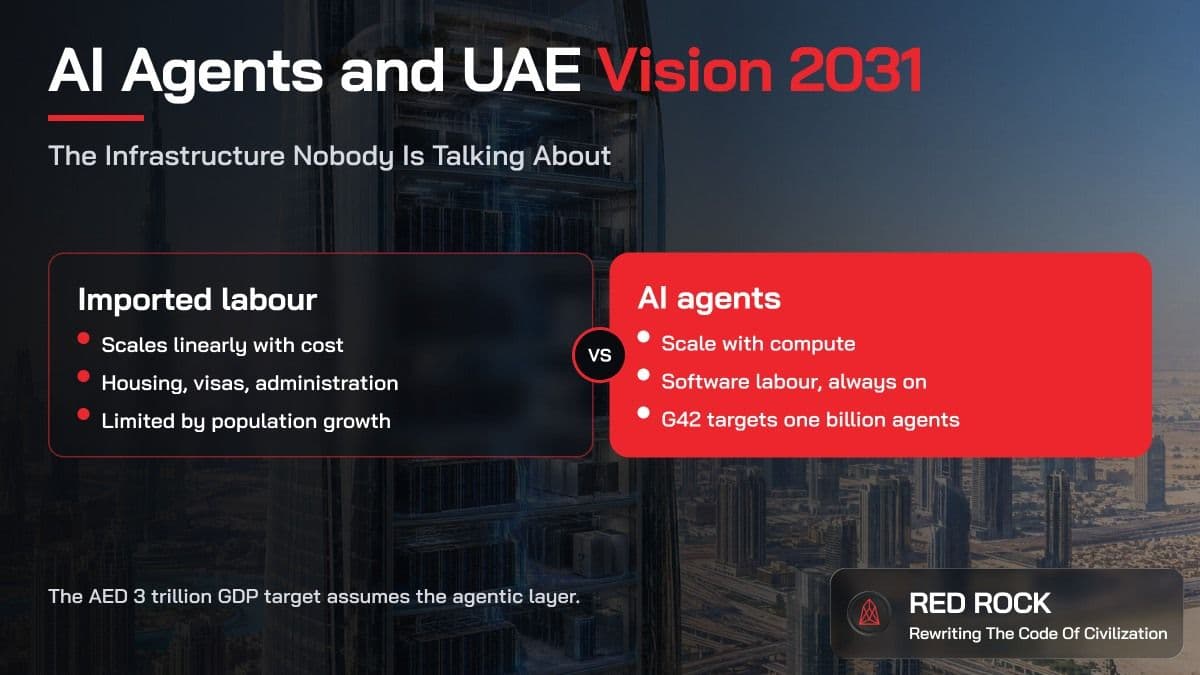
The UAE's development model has always solved capability gaps by importing them. Construction capacity, professional services, hospitality operations: for five decades, the answer to "who will do this work" was global recruitment at a scale no other nation attempted. It worked brilliantly, and it has limits. Imported labour scales linearly with cost, housing, infrastructure, and administrative burden. You cannot double an economy by doubling a population without transforming the country into something its own vision does not describe.
AI agents break that constraint. An agent performing compliance checks, reconciling trade documentation, qualifying investment leads, or monitoring logistics flows scales with compute, not with residency permits. The G42 ambition announced at Davos in January 2026, one billion deployed agents spanning roles from petroleum engineering to cybersecurity, is best understood in exactly these terms: it is a workforce target, denominated in software.
This reframes Vision 2031 entirely. The vision's targets are not aspirational rhetoric awaiting conventional execution. They are calibrated to an economy in which a substantial share of procedural knowledge work is performed by autonomous systems running on sovereign infrastructure. The AED 3 trillion GDP target assumes the agentic layer. Remove it, and the arithmetic strains. Include it, and the numbers become an engineering problem rather than a hope.
What This Means If You Operate Here
For organizations in the UAE and the wider GCC, this analysis has three practical consequences.
First, agent adoption in this market is not a private technology choice. It is alignment with declared national direction. A company deploying AI agents on its operations in Dubai or Abu Dhabi is moving with the current of government policy, procurement priorities, and regulatory attention. In an economy where public and private sectors move in coordination to a degree Western markets rarely achieve, that alignment has commercial weight.
Second, the window for differentiation is now, not at maturity. When agentic operations become standard, and the national strategy is explicitly designed to make them standard, the advantage will belong to organizations with two or three years of accumulated experience in agent governance, workflow design, and human oversight structures. That experience cannot be purchased retroactively. It is earned in deployment.
Third, the sectors named as priorities in the national strategy, energy, logistics, tourism, healthcare, financial services, are precisely where agent economics are strongest: high transaction volume, structured workflows, around-the-clock operations. If your organization lives in one of those sectors, you are not adjacent to Vision 2031. You are inside its execution plan, whether you have decided to participate or not.
The Infrastructure That Was Hiding in Plain Sight
National visions are usually judged by their monuments: the towers, the ports, the campuses. Vision 2031 will have those. But its defining infrastructure will be largely invisible, a layer of autonomous software agents running on sovereign compute, executing the procedural work of a trading, logistics, and services economy at a scale and tempo no human workforce could match.
That layer is being built now, in policy documents, in data centres rising outside Abu Dhabi, in sovereign investment vehicles, and in the operations of the enterprises that move first. The countries that treated AI as a feature will spend the 2030s retrofitting. The UAE treated it as infrastructure from the beginning, and wrote a national vision that quietly depends on it.
At Red Rock Technology, we build and operate AI agent infrastructure for enterprises from our base in Dubai Internet City, under agreements governed by DIFC law. We read Vision 2031 the way we read any serious plan: by asking what must be true for the numbers to work. The answer, in this case, is the business we are in.
Next in this series: Deploying AI Agents in Dubai: Regulation, Data Residency, and DIFC Law.
Recent Posts

October 6, 2026

September 22, 2026

September 15, 2026

September 10, 2026

September 8, 2026
Related Posts
October 6, 2026
September 22, 2026
September 15, 2026
September 8, 2026

August 25, 2026
 Email
Email Location