
AI Agents vs Chatbots: Why the Difference Matters for Your Bottom Line



Red Rock Editorial Team

August 4, 2026

Last Updated on August 4, 2026

8 min read
Two years ago, most organizations in this region bought a chatbot. It sat on the website, answered common questions, deflected some support tickets, and produced a modest efficiency gain that eventually plateaued. Many executives concluded from that experience that enterprise AI delivers incremental improvement, not structural change.
That conclusion is correct about chatbots and wrong about the technology as a whole. The distinction is not academic. It determines where the returns come from, how they scale, and whether the investment shows up on a cost line or in the operating model. This article explains the difference in the only terms that matter to a board: money.
Where the Value Actually Comes From
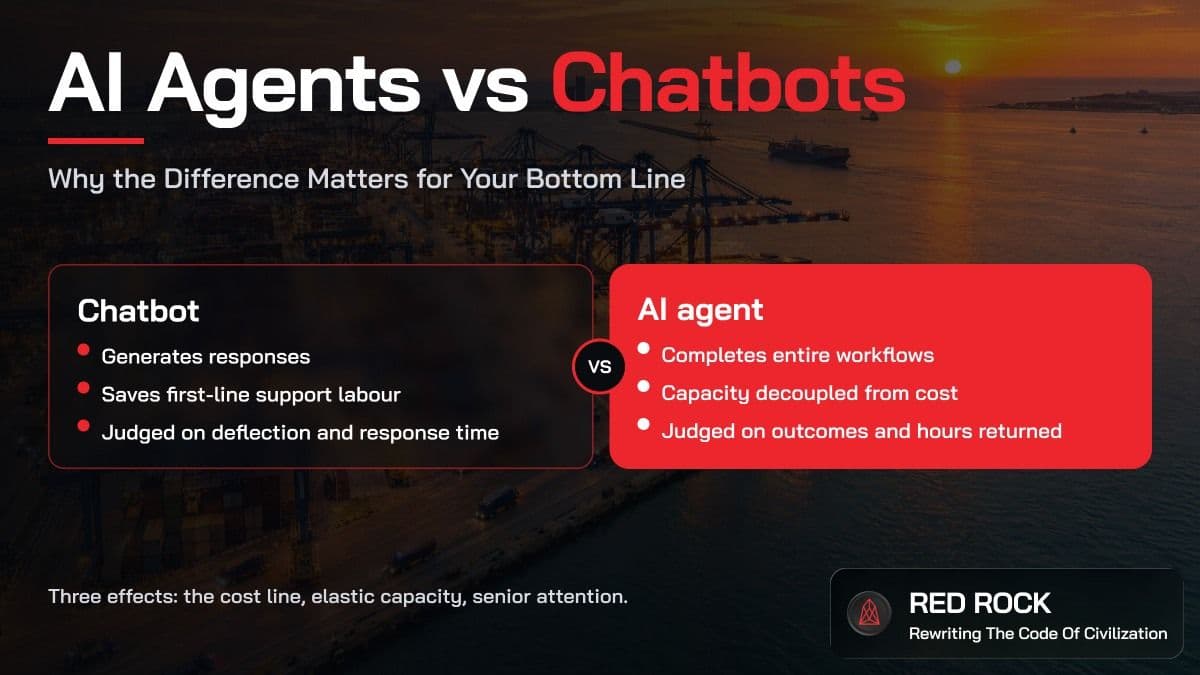
A chatbot generates responses. Its economic contribution is the labour saved in producing those responses, typically first-line support. The saving is real, bounded, and easy to model: fewer tickets reaching a human, faster handling, some deflection.
An agent completes work. Its economic contribution is the labour saved across an entire workflow, plus the value of the work being done at a speed and volume no human team would attempt. The invoice is not just discussed, it is reconciled. The lead is not just answered, it is qualified, enriched, routed, and followed up. The compliance register is not just queried, it is maintained.
That difference produces three distinct financial effects, and understanding them separately is what separates a well-argued business case from an optimistic one.
Effect One: The Cost Line
The obvious effect is direct cost. Procedural work performed by an agent runs at a fraction of its loaded human cost, and the comparison in this market is more favourable than most executives assume once the full picture is included: salary, visa, housing allowance, recruitment, onboarding, management overhead, and the productivity lost to turnover in roles with high attrition.
But the cost effect has a ceiling, and honest advisors say so. You can only automate theprocedural share of a function, and no serious deployment removes human oversight.
Organizations that build their entire case on headcount reduction usually reach a plateau, the same plateau the chatbot generation hit, and conclude the technology underdelivered.
The cost line is where agent value starts. It is not where it ends.
Effect Two: Capacity Decoupled From Cost
The second effect is where the economics change character rather than degree.
Human capacity scales in steps. To double throughput you hire, onboard, and manage roughly double the people, and you carry that cost whether volume holds or falls. Agent capacity scales continuously. Volume doubles, the agent handles it. Volume triples during a peak season, the agent handles that too. Volume falls, the cost falls with it.
For businesses in the UAE this matters more than in most markets, because so much of the economy is cyclical and event-driven. Trade flows, tourism seasons, property cycles, exhibition calendars, quarter-end financial surges. Organizations here have always paid a structural premium to staff for peak and carry that staffing through trough. Agents make throughput elastic. That is not a cost saving. It is the removal of a constraint that has shaped how companies in this region plan, hire, and price for decades.
Effect Three: The Return of Senior Attention
The third effect is the largest and the least measured.
In every organization we work with, the binding constraint is not capital and not technology.
It is the attention of the twenty or thirty people who actually move the business. Those people spend a substantial share of their week on work that is necessary, procedural, and entirely beneath their judgment: chasing status updates, assembling recurring reports, reconciling records, filtering inbound noise to find the three items that deserve a decision.
Agents return those hours. And the value of a returned hour is not the cost of the hour, it is the value of what a senior person does with it: the client relationship deepened, the deal structured, the market entered, the problem caught early. This is why the strongest agent business cases in this market are not written as efficiency projects at all. They are written as capacity projects, and their headline metric is not cost per transaction but decisions made per week by the people qualified to make them.
Why the Chatbot Business Case Cannot Be Reused
A practical warning for anyone building the internal argument. The evaluation framework most companies inherited from their chatbot project actively understates agent value,because it measures the wrong things.
Chatbot metrics are interaction metrics: containment rate, deflection, response time, satisfaction on answered queries. Agent metrics are outcome metrics: workflows completed end to end, exceptions correctly escalated, cycle time from trigger to resolution, error rate against a human baseline, and hours returned to named senior roles. An organization that evaluates an agent pilot with chatbot metrics will conclude the pilot performed adequately and miss the entire structural argument.
There is also a governance dimension to the business case that chatbots never raised.
Because agents act, they require the controls we covered in the article on regulation and
DIFC law: scoped permissions, logged actions, defined escalation, and in the DIFC an accountable officer for autonomous systems. Building those controls costs something. It also converts into commercial advantage, because in regulated sectors here, government, banking, healthcare, energy, the vendor who can evidence governance wins work the vendor who cannot never reaches.
The Test to Apply This Week
If you want a fast diagnostic, take any function in your organization and ask what happens after your current AI tool responds. If a person then has to do the work, you own a chatbot, and your returns will remain incremental. If the work completes and a person reviews it, you own an agent, and your returns compound with volume.
Then ask the harder question, the one that determines whether this becomes a technology project or a strategic one: if the procedural ninety percent of this function ran continuously without our people touching it, what would our people do instead, and what is that worth?
Companies that answer the first question buy tools. Companies that answer the second redesign how they operate. In a market where national infrastructure, regulation, and policy are all being tooled for agentic operations, the second group is the one that will be difficult to compete with in three years.
At Red Rock Technology we design, deploy, and operate governed AI agents for enterprises from our base in Dubai Internet City, under agreements governed by DIFC law. We build the business case the same way we build the systems: on outcomes completed, not interactions handled.
Next in this series: AI Agents in the GCC: What Works in Silicon Valley Fails in the Gulf.
Message Jane
Recent Posts

October 6, 2026

September 22, 2026

September 15, 2026

September 10, 2026

September 8, 2026
Related Posts
October 6, 2026
September 22, 2026
September 15, 2026
September 8, 2026

August 25, 2026
 Email
Email Location