
Deploying AI Agents in Dubai: Regulation, Data Residency, and DIFC Law



Red Rock Editorial Team

July 21, 2026

Last Updated on July 21, 2026

10 min read
In the first two articles of this series we made the strategic case: the UAE is building the operating environment for AI agents, and Vision 2031 quietly depends on them. This article is different. It is written for the executive who has moved past “why” and is now asking the questions that actually delay deployments: under which law does my agent operate, where does the data live, and who is accountable when an autonomous system acts on my company’s behalf?
These questions have precise answers in the UAE. In fact, they have better answers here than in almost any other jurisdiction, which is itself a competitive fact most companies have not yet priced in. What follows is a practical map. It is not legal advice, and any deployment decision should be made with qualified counsel. But it will let you walk into that conversation knowing the terrain.
First Principle: There Is No UAE AI Act, and That Is Deliberate
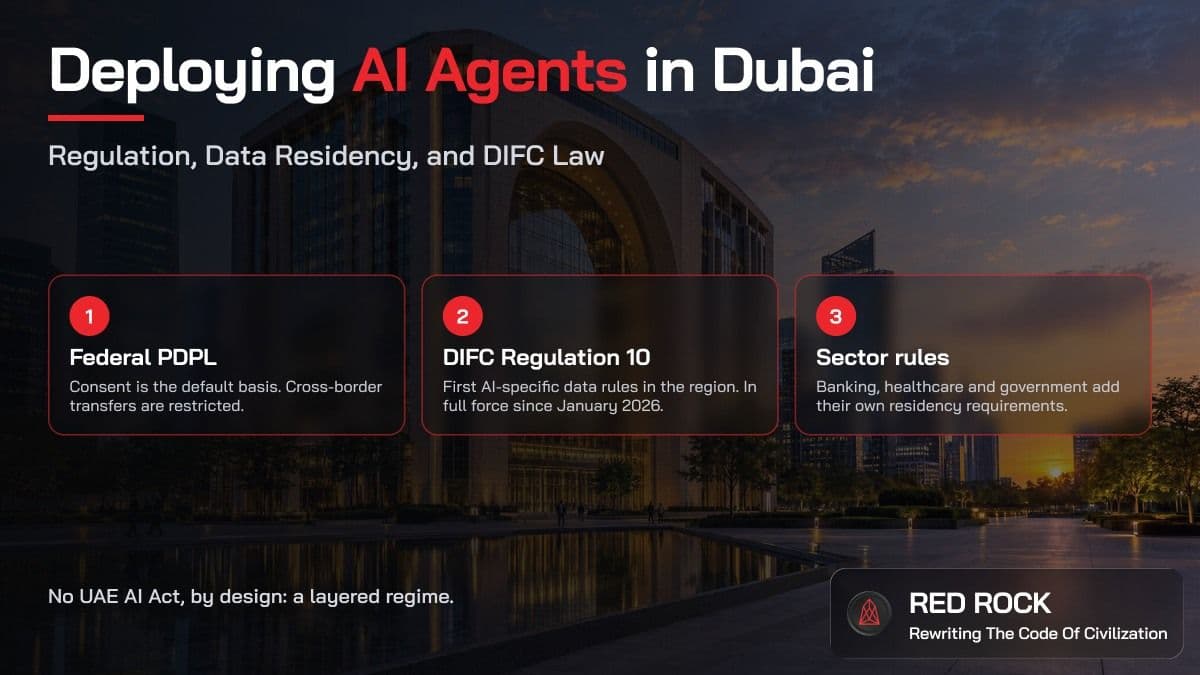
Executives arriving from Europe often ask for “the UAE equivalent of the EU AI Act.” There isn’t one, and the absence is a policy choice, not a gap. The UAE has concluded that AI moves too fast for a single horizontal statute to stay current. Instead, it operates a layered regime: federal data protection law, free zone frameworks with their own rules, sector-specific regulators, and national ethical charters such as the UAE Charter for the Development and Use of AI issued in 2024.
The practical consequence: your compliance obligations depend on where your entity is established, whose data your agents touch, and which sector you operate in. Three layers matter for almost every agent deployment.
Layer One: The Federal PDPL
The foundation is Federal Decree-Law No. 45 of 2021 on the Protection of Personal Data, the PDPL. It applies to personal data processing on the UAE mainland and reaches extraterritorially wherever the data of UAE residents is processed. Two features deserve an agent deployer’s attention.First, consent is the default lawful basis. Unlike GDPR, the PDPL does not recognize legitimate interests as a standalone justification for processing. An agent that enriches customer records, scores leads, or personalizes communications needs its lawful basis designed in from the start, not retrofitted.
Second, the law restricts cross-border transfers of personal data to jurisdictions without adequate protection unless a lawful mechanism is in place. Read that sentence again with an architect’s eyes: an AI agent sending a customer’s personal data to a model endpoint hosted abroad for inference is performing a cross-border transfer. Most companies deploying agents on foreign-hosted APIs have not made this connection. The regulator eventually will. The executive regulations that operationalize the PDPL’s detail are still pending, with full compliance expected by the beginning of 2027. That timing is a gift for early movers: the direction of the law is known, the enforcement clock has a horizon, and companies that build compliant agent architectures now will meet the deadline as a formality rather than a crisis.
Layer Two: DIFC, the Only AI-Specific Data Regulation in the Region
Here is where the UAE stops being merely competitive and becomes genuinely distinctive.
The Dubai International Financial Centre runs its own English-language common law framework, its own courts, and its own data protection regime under DIFC Law No. 5 of 2020. And in September 2023, the DIFC Commissioner of Data Protection issued Regulation 10, governing personal data processed through autonomous and semi-autonomous systems.
Pause on what that means. Regulation 10 is the first instrument in the Middle East, North Africa, and South Asia region to regulate AI systems as such, rather than as an incidental form of data processing. It deliberately uses the broad term “System” to capture any machine-based system operating with autonomy that processes personal data and generates output. That is a legal definition of an AI agent, written before most of the market knew it needed one. The regulation entered full enforcement in January 2026, which makes this the first year it has real teeth.
For deployers, Regulation 10 brings three concrete obligations. Impact assessments before high-risk processing, with fines for skipping them reaching fifty thousand dollars per violation. Enhanced transparency toward data subjects, including rights to object in the context of profiling and automated decisions. And the creation of a new accountable role, the Autonomous Systems Officer, a designated person responsible for AI system oversight, distinct from the traditional Data Protection Officer.Silicon Valley reads requirements like these as friction. Serious enterprises read them correctly: as a trust framework. A bank, a government entity, or a healthcare group evaluating an AI agent vendor can now ask a precise question, “are you operating under
Regulation 10, and who is your accountable officer,” and receive a verifiable answer. Jurisdictions that certify accountability convert regulation into a sales asset for the companies that comply early.
Layer Three: Sector Rules and the Residency Question
On top of the general frameworks sit the sector regulators, and for agent deployments the decisive one is often the question of where data physically lives. The Central Bank of the UAE governs how licensed financial institutions use cloud services and outsource processing, including where regulated financial data may reside. Healthcare operates under its own ICT rules dating back to 2019, with strong localization expectations. Government workloads carry sovereignty requirements as a matter of course. This is precisely where the infrastructure story from our first article becomes a legal story.
Sovereign compute inside the UAE, the Stargate cluster and the broader national capacity coming online, means data residency is no longer a constraint that forces a choice between frontier capability and compliance. An enterprise can run inference on advanced models while keeping prompts, logs, and vector stores inside national borders. The architecture, not the model choice, is what determines residency. Companies that understand this design their agents to be deployable in regulated sectors from day one; companies that do not will spend 2027 re-platforming.
Why the DIFC Contract Is the Quiet Advantage
There is a final element that rarely appears in technology commentary and constantly appears in deal negotiations: governing law. An AI agent operating on your core workflows is delivered under a services agreement, and when something goes wrong, that agreement is what matters. Liability allocation, service levels, data handling, termination, audit rights.
Agreements governed by DIFC law are written in English, interpreted under common law principles familiar to any international counterparty, and enforceable before a dedicated, internationally respected court system. For a multinational deciding whether to trust an autonomous system vendor in the Gulf, that combination removes an entire category of perceived risk. It is the difference between asking a counterparty to trust an unfamiliar legal system and offering them one they already understand.
The Deployment Checklist
Distilled to its essentials, a defensible agent deployment in Dubai answers five questions before the first workflow goes live. Which entity deploys the agent, and therefore which regime applies: mainland PDPL, DIFC, or another free zone. What lawful basis covers each category of personal data the agent touches. Where inference, logs, and stored embeddings physically reside, and whether any step constitutes a cross-border transfer.
Whether the use case qualifies as high-risk processing requiring an impact assessment and, in DIFC, an accountable Autonomous Systems Officer. And under which governing law the services agreement sits.
None of these questions is difficult. All of them are unavoidable. The companies that answer them in the design phase deploy in weeks; the companies that discover them in procurement review deploy in quarters.
Regulation as Moat
The prevailing assumption is that regulation slows AI adoption. In the UAE, the opposite dynamic is taking shape. A layered but navigable regime, the region’s only AI-specific data regulation, sovereign infrastructure that solves residency, and a common law contracting environment together produce something rare: a jurisdiction where an enterprise can deploy autonomous agents on core operations and defend that decision to its board, its auditors, and its regulator with documents rather than assurances. That is why we structured Red Rock Technology the way we did: based in Dubai Internet City, delivering AI agent infrastructure under agreements governed by DIFC law, with compliance designed into the architecture rather than appended to it. In this market, the legal design is not paperwork. It is part of the product.
Next in this series: What Are AI Agents? A Practical Guide for UAE Business Leaders.
Message Jane
Recent Posts

October 6, 2026

September 22, 2026

September 15, 2026

September 10, 2026

September 8, 2026
Related Posts
October 6, 2026
September 22, 2026
September 15, 2026
September 8, 2026

August 25, 2026
 Email
Email Location