
What Are AI Agents? A Practical Guide for UAE Business Leaders



Red Rock Editorial Team

July 28, 2026

Last Updated on July 28, 2026

8 min read
The first three articles in this series argued a thesis: the UAE is building the operating environment where AI agents will run at national scale, Vision 2031 quietly depends on that layer, and the legal framework to deploy it already exists. Several readers asked a fair question in response. Before the strategy, define the object. What exactly is an AI agent, and how is it different from the AI tools my company already uses?
This article is that definition, written for decision makers rather than engineers. No mathematics, no vendor vocabulary. By the end you will be able to look at any process in your organization and answer the only question that matters commercially: is this a job for an agent, and what would change if it were?
The Definition That Actually Helps
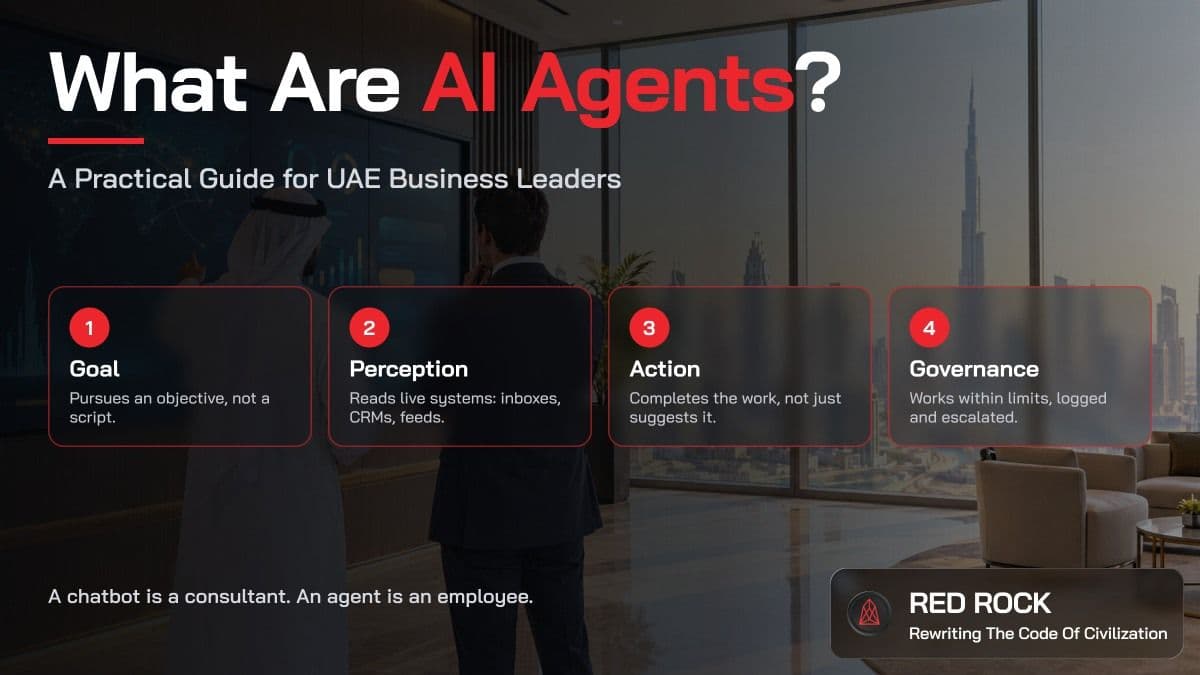
Strip away the marketing and an AI agent is a software system with four properties working together.
It has a goal, not a script. You do not tell an agent each step; you give it an objective, “collect the overdue invoices in this ledger,” “qualify the inbound leads from this campaign,” “keep this compliance register current,” and it determines the steps. It perceives its environment. An agent reads the systems around it: inboxes, databases, CRMs, documents, market feeds. It acts on live information, not on a snapshot from the day it was configured.
It takes actions with real effect. This is the decisive property. A chatbot produces text for a human to act on. An agent acts: it sends the follow-up, updates the record, files the report, escalates the exception. Its output is completed work, not a suggestion of work.
It operates under governance. A serious agent runs inside defined limits: which systems it may touch, which decisions it may take alone, which must go to a human, and how every action is logged. Autonomy without governance is not an enterprise product. It is a liability.
Hold those four properties together, goal, perception, action, governance, and you have the working definition. Everything else in the field is detail.
An Analogy Every Gulf Executive Will Recognize
Here is the frame we find lands best in this region. A chatbot is a consultant: you ask, it answers, and the work of acting on the answer remains yours. An agent is an employee: you delegate an outcome, it performs the work, and you review the results.
The analogy is precise enough to guide real decisions. You would not hire an employee without a job description, access rights, a reporting line, and a probation period. An agent deployment needs exactly the same things: a scoped mandate, defined system permissions, an escalation path to a named human, and a supervised period before autonomy expands.
Companies that treat agents like software installations struggle. Companies that treat them like structured hires succeed, because the management disciplines they already possess apply almost unchanged.
And the economics follow the same logic with one difference of kind: this employee works around the clock, performs identically at any volume, and can be replicated in minutes when demand doubles. In an economy that has spent five decades importing operational capacity, that difference is not incremental. It is the next chapter of the model, as we argued in our Vision 2031 analysis.
What Agents Do Well, and What They Should Not Do
The honest part of any practical guide is the boundary line. Agents excel at work that is procedural, high-frequency, and rule-governed, precisely the work that consumes most of the operating cost in a services economy. Reconciling documents. Chasing approvals.
Monitoring feeds and flagging exceptions. Qualifying, enriching, and routing inbound demand. Producing the recurring report nobody enjoys assembling. In sectors that dominate the UAE economy, trade, real estate, logistics, financial services, hospitality, government services, this category of work is enormous, and every hour of it currently costs skilled human attention.
Agents should not, today, be given unsupervised authority over decisions that are irreversible, high-stakes, and judgment-heavy: final credit decisions, medical determinations, legal positions, large discretionary payments. Not because the technology cannot attempt them, but because accountable organizations keep humans on decisions where the cost of a rare error exceeds the value of automation. The design pattern is consistent: agents compress the ninety percent of a workflow that is procedure, and route the ten percent that is judgment to a human, with full context attached. The result is not fewer decisions made by your people. It is your people making only the decisions that deserve them.
Why This Definition Matters More in the UAE Than Almost Anywhere
A definition is useful; a definition connected to your operating environment is strategy.
Three connections matter here.
First, the infrastructure assumption. Agents work continuously, which means they consume inference continuously. The compute capacity rising in Abu Dhabi, the Stargate UAE cluster and the wider sovereign build-out we examined in the first article, exists precisely to make always-on agents economically viable in-region, with data residency intact.
Second, the regulatory assumption. The DIFC’s Regulation 10 already defines, in law, systems that process data and act with autonomy, and assigns accountability for them.
When your board asks who answers for the agent’s actions, this jurisdiction has an answer written down. Most do not.
Third, the policy assumption. When national figures speak of deploying agents by the hundreds of millions as an instrument of GDP growth, they are describing the same object defined above: goal-driven, governed software labour. Understanding the definition means understanding what the national economy is being tooled for.
The Question to Take Back to Your Leadership Team
Definitions earn their place when they change a conversation. Here is how to use this one.
Take any department and ask three questions in sequence. Which outcomes here are procedural enough to delegate to a governed agent? What would our cost structure look like if that work ran continuously at machine tempo? And what would our best people do with the hours returned to them?
In our experience the third question is where the real value hides. The first two produce efficiency. The third produces growth, because the scarcest resource in every organization we meet in this market is not capital and not technology. It is senior human attention, and agents are the first tool in history that returns it at scale.
An AI agent, then, is not a smarter chatbot. It is a new category of operational capacity: software that pursues goals, perceives context, takes governed action, and answers to a human chain of command. The UAE is building the infrastructure, the law, and the policy frame for that capacity faster than any other jurisdiction. The remaining variable is which organizations learn to manage it first.
At Red Rock Technology we design, deploy, and operate governed AI agents for enterprises from our base in Dubai Internet City, under agreements governed by DIFC law. We wrote this guide because the market conversation is full of the word agent and short on its meaning,and because in this market, the companies that define their terms precisely tend to be the ones institutions trust.
Next in this series: AI Agents vs Chatbots: Why the Difference Matters for Your Bottom Line.
Recent Posts

October 6, 2026

September 22, 2026

September 15, 2026

September 10, 2026

September 8, 2026
Related Posts
October 6, 2026
September 22, 2026
September 15, 2026
September 8, 2026

August 25, 2026
 Email
Email Location