
From Free Zones to AI Zones: How Dubai Is Engineering Agentic Advantage



Red Rock Editorial Team

September 2, 2026

Last Updated on September 2, 2026

9 min read
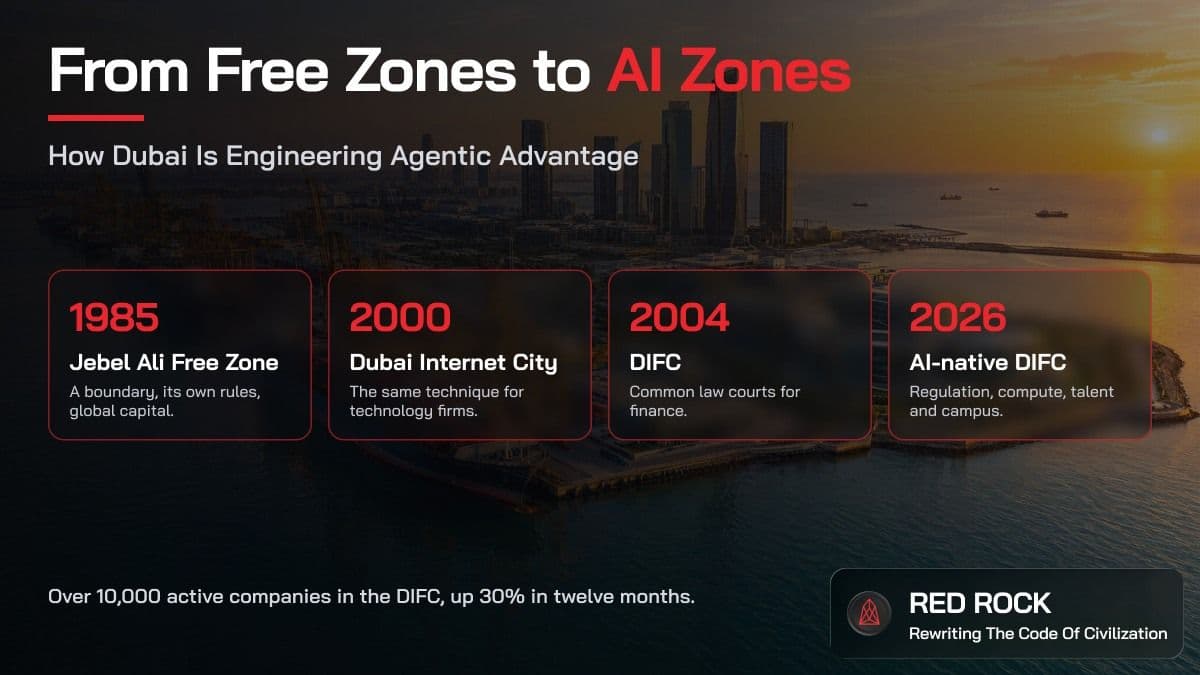
Dubai’s most important export has never been a commodity or a service. It is an institutional technique. In 1985, Jebel Ali Free Zone demonstrated that a city could draw a boundary, write a distinct set of rules inside it, and attract global capital by removing the frictions that the surrounding legal and commercial environment imposed. Dubai Internet City applied the same technique to technology companies in 2000. The Dubai International Financial Centre applied it to finance in 2004, with its own common law framework and its own courts.
Each zone solved the same problem in a different sector: how to make a location competitive not by having the best natural endowment, but by engineering the best operating conditions. The pattern worked so well that the rest of the world spent two decades copying it.
Now Dubai is applying the technique to artificial intelligence, and specifically to the conditions autonomous agents require in order to work. Understanding this as the continuation of a forty-year institutional method, rather than as a new marketing campaign, is the key to reading what is happening here correctly.
What a Free Zone Actually Is
Strip away the property development and a free zone is a piece of institutional engineering with three components. A defined jurisdiction with its own regulatory logic. A concentration of the specific infrastructure the target industry needs. And a coordinating authority that treats attracting and serving companies as its entire purpose, rather than as one function among many.
The insight underlying the model is that competitiveness is designable. Singapore knew it.
Dubai industrialized it. And the crucial move was always to identify what a given industry found frictional elsewhere, then build a place where that friction did not exist.
For trade it was customs, ownership rules, and repatriation. For finance it was legal certainty and an internationally credible court system. For AI agents, the frictions are different, and Dubai has identified them precisely.The Frictions of the Agentic Era Across the previous eight articles in this series, four frictions have appeared repeatedly, because they are the ones that actually stall enterprise agent deployments anywhere in the world.
Regulatory ambiguity: who is accountable when an autonomous system acts, and under which law. Compute and data residency: where inference physically runs and whether the answer satisfies regulators. Talent concentration: the scarce people who can design, govern, and operate these systems. And institutional trust: whether a counterparty can verify that an AI operator meets a standard rather than merely claims to.
A traditional free zone removes friction for capital and companies. An AI zone removes friction for autonomous systems and the organizations that run them. It is the same technique, pointed at a new object.
The Evidence That This Is Deliberate
Consider what has been assembled, and how tightly it maps to those four frictions.
On regulation, the DIFC issued Regulation 10 on autonomous and semi-autonomous systems in 2023, the first instrument of its kind in the region, in full enforcement since
January 2026. That is the accountability friction addressed inside a jurisdiction whose courts international counterparties already trust.
On infrastructure and institutional integration, in April 2026 the DIFC announced it would become the world’s first AI-native financial centre, explicitly framed not as experimenting with AI at the edges but as embedding it across legal frameworks, regulatory systems, talent development, and physical infrastructure, with a full-stack AI Campus combining regulation, training, compute, and physical AI. Read that list again: it is the four frictions, itemized, and assigned to a single coordinating authority. This is the free zone method in its purest form.
On concentration, the Dubai AI Campus within the DIFC has become the largest dedicated AI cluster in the region, and the ecosystem numbers show the gravity working. The DIFC reached over ten thousand active registered companies by mid-2026, up thirty percent in twelve months, with AI, FinTech, and innovation firms growing nearly forty percent to close to two thousand entities. Clusters compound: every additional serious operator makes the location more valuable to the next one.
On the surrounding city, the Dubai Economic Agenda D33 sets a target of AED 100 billion in annual economic contribution from digital transformation, the Dubai Universal Blueprint for AI has placed Chief AI Officers across government entities, and Dubai AI Week has becomea fixed point on the global calendar, with the 2026 festival built explicitly around agentic use cases, including competitions in which teams build autonomous agents against real problems. The Dubai Future Foundation continues to operate as the talent and programme engine underneath all of it.
None of these are isolated announcements. They are coordinated moves by a small number of authorities, each of which understands its role in the same design.
Why Coordination Is the Real Advantage
Here is the point Western observers most consistently miss. Silicon Valley has more capital, more researchers, and more frontier models than Dubai. What it does not have is a coordinating authority able to align regulation, infrastructure, talent programmes, and institutional trust around a single objective on a multi-year timeline.
In most jurisdictions, an AI regulation emerges from one process, data centre capacity from another, talent policy from a third, and the financial sector’s adoption from a fourth, on independent timelines with independent incentives. The result is that the frictions never clear simultaneously, and enterprises wait. In Dubai, the DIFC can write the rule, house the compute, run the campus, host the festival, and register the company, and it can do all of this within a jurisdiction whose contracts are enforceable in a common law court. That is not a regulatory advantage or an infrastructure advantage. It is an institutional design advantage, and it is the one that free zones have always rested on.
The consequence for autonomous systems is specific. Agents need every friction cleared at once to move from pilot to production: the legal basis, the residency answer, the accountable role, the trusted counterparty. A place where those clear together is a place where deployment timelines collapse from quarters to weeks. That compression, more than any single policy, is what the phrase agentic advantage should mean.
The Historical Rhyme
Free zones did not make Dubai the world’s largest port operator or a top-tier financial centre overnight. They created conditions, and companies that arrived early built positions that later entrants found difficult to dislodge. The firms that established in Jebel Ali in the 1980s and in the DIFC in the mid-2000s did not merely benefit from a location. They became part of the reason the location worked.
The same dynamic is now available to organizations willing to see the AI zone for what it is.
Deploying governed agents from within this jurisdiction, in this window, is not only an operational decision. It is participation in a cluster at the point where clusters confer the most advantage: early, when the authorities are still shaping the rules and thecounterparties are still deciding whom to trust.
We noted in our first article that Dubai is not trying to win the model race but to own the operating environment. This article is the mechanism behind that claim. Dubai has spent forty years learning how to engineer operating environments, and it is applying everything it learned to the technology that most needs one.
At Red Rock Technology we design, deploy, and operate governed AI agents for enterprises from our base in Dubai Internet City, under agreements governed by DIFC law. We chose to build inside the zones rather than beside them for the reasons this article sets out. The advantage is designed. It is available to those who position within it.
Next in this series: The Infrastructure Maturity Model: How Companies Become AI-Ready.
Recent Posts

October 6, 2026

September 22, 2026

September 15, 2026

September 10, 2026

September 8, 2026
Related Posts

February 26, 2026

February 24, 2026

February 20, 2026

December 12, 2025
 Email
Email Location